An importer should not approve an air hockey table from a photo, a nominal foot size or a short product name. A workable purchase specification must define the table size, playfield, blower system, voltage, frequency, plug, scoring method, accessories, packing, inspection method, warranty scope and spare-parts support. These details affect cost, freight, installation, compliance review and after-sales risk.
The practical rule is simple: treat every attractive catalog listing as an inquiry starting point, not as a finished specification. Before paying a deposit or confirming production, ask the supplier to close every field that affects the destination market and the intended use.
Key Takeaways
- Compare the exact specification, not only the label “6 ft.”
- Use three measurements: assembled size, operating space and packed size.
- Blower wattage alone does not prove even airflow across the playing surface.
- Confirm voltage, frequency and plug type separately and in writing.
- Calculate loading from final carton count and packing dimensions, not assembled table dimensions.
- Do not call a model commercial-duty unless the supplier confirms intended use, warranty and service support.
- Test a production sample or finished unit against a written acceptance checklist before shipment.
What Should an Importer Confirm Before Requesting a Price?
A useful quotation starts with a controlled specification. If two suppliers quote different cabinet structures, electrical systems, scoring methods, accessory sets or packing scopes, the prices are not directly comparable.
| Buying item | Minimum information to request | Why it matters |
|---|---|---|
| Model identity | Model number, current product photo and revision | Prevents a price from being attached to a different cabinet or configuration |
| Size | Assembled size and playing-field size | Separates the product footprint from the actual playing area |
| Blower | Quantity, label data, location and service access | Affects airflow, replacement planning and maintenance access |
| Electrical | Rated voltage, frequency, power, plug and cord | Determines whether the table matches the destination supply |
| Scoring | Manual or electronic, with power and battery details where relevant | Changes the electrical scope and spare-part list |
| Accessories | Striker and puck quantities, sizes and colors | Avoids incomplete arrival sets |
| Packing | Carton count, dimensions, net weight and gross weight | Required for freight and warehouse planning |
| Order scope | Quantity, branding, packaging and destination | Determines which configuration and quotation apply |
| After-sales | Warranty, exclusions, spare parts and response process | Clarifies what happens after installation |
The first expert correction is straightforward: a product name is not a specification. “Air hockey table,” “6-foot air hockey table” and even a model number may still be incomplete if the model has destination-specific electrical, packing or accessory options.
How Should Importers Compare Air Hockey Table Size?
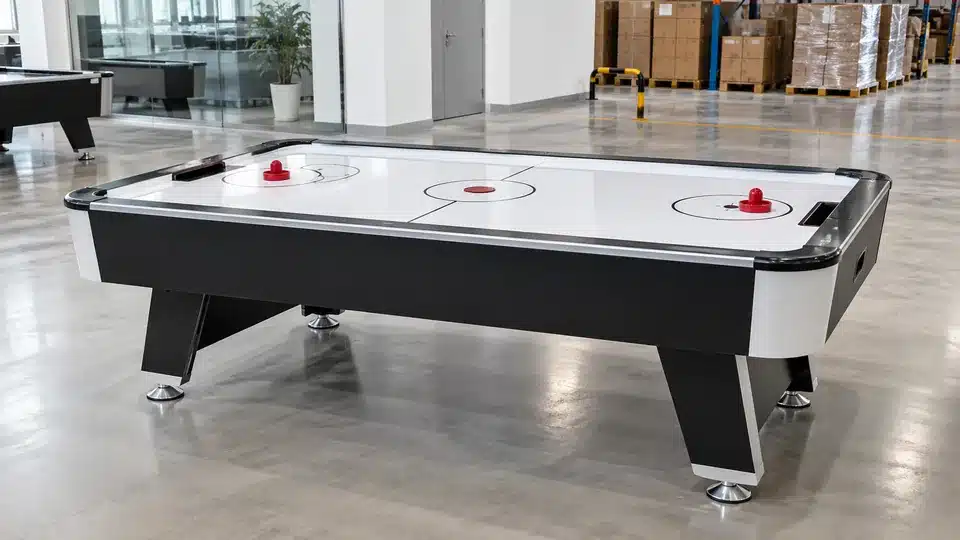
Use three different size concepts. They answer different commercial questions, and mixing them up can create freight, installation and user-experience problems.
1. Assembled dimensions
Assembled dimensions describe the cabinet after setup. They help with floor planning, but they do not show the full operating zone around the game.
2. Operating space
Operating space includes the table, players at both ends, arm movement, spectators, circulation and access to the power switch or service panels. A cabinet can fit on a floor plan while the table remains awkward to play or difficult to maintain.
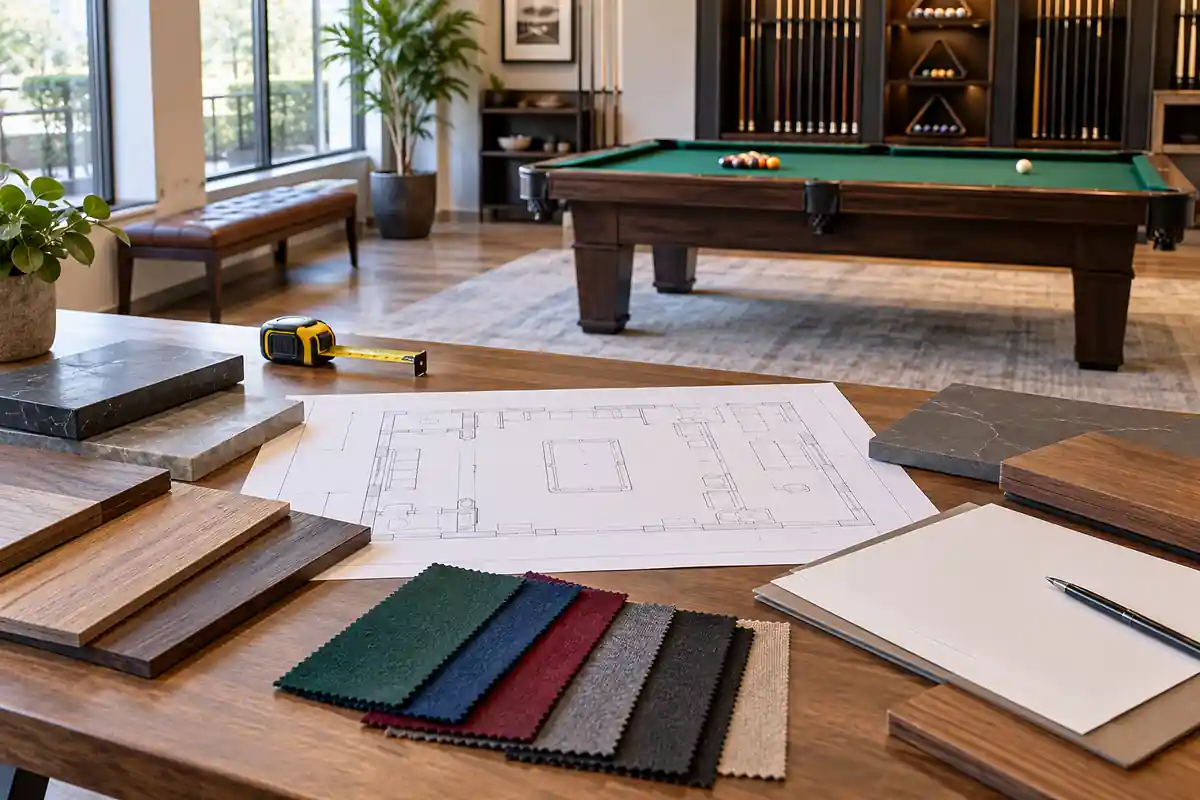
There is no single clearance number that fits every venue. Ask the project designer or operator to mark the actual cabinet outline and player zones on a scaled plan. Check doors, columns, fixed seating, outlets, emergency routes and nearby high-energy games.
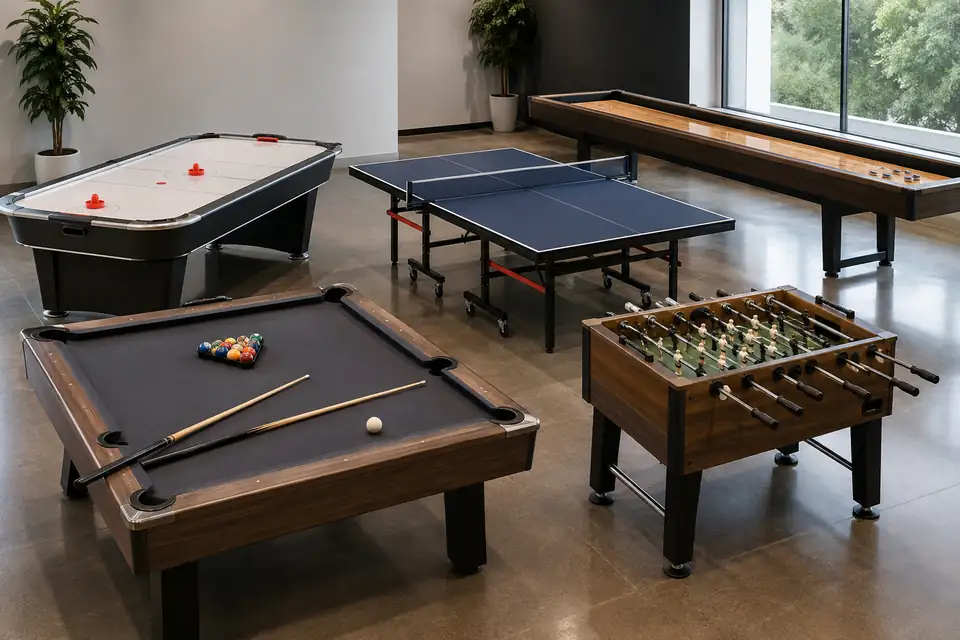
For mixed game-room projects, the broader game table category comparison explains why the active playing zone matters for air hockey, pool, table tennis, shuffleboard and foosball.
3. Packed dimensions
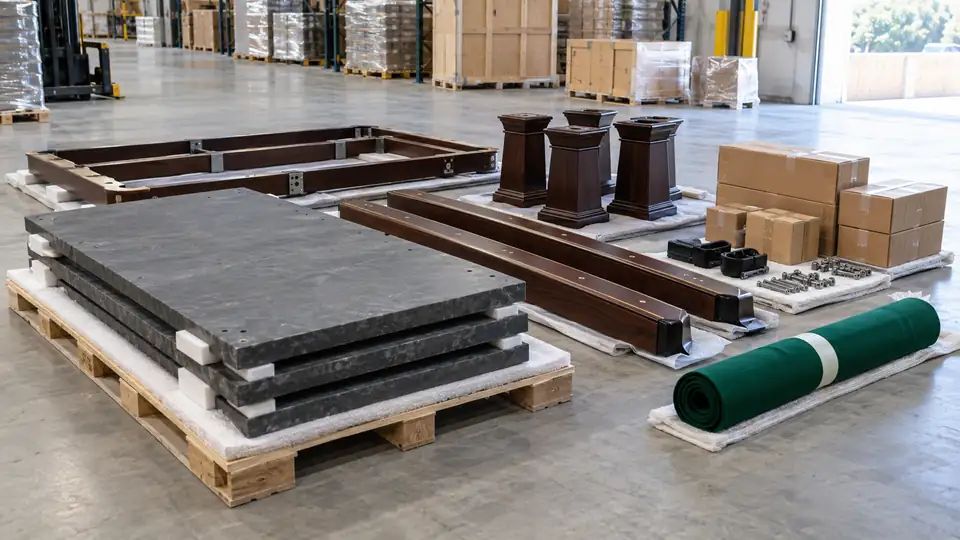
Packed dimensions determine freight volume, warehouse slots, doorway access before assembly and container-loading feasibility. They may look very different from the standing cabinet because legs, rails or accessories can be packed separately.
Do not use product length multiplied by product width to estimate shipping volume. Ask for the actual carton dimensions and carton count for the final order configuration.
What Should Buyers Check About the Blower?
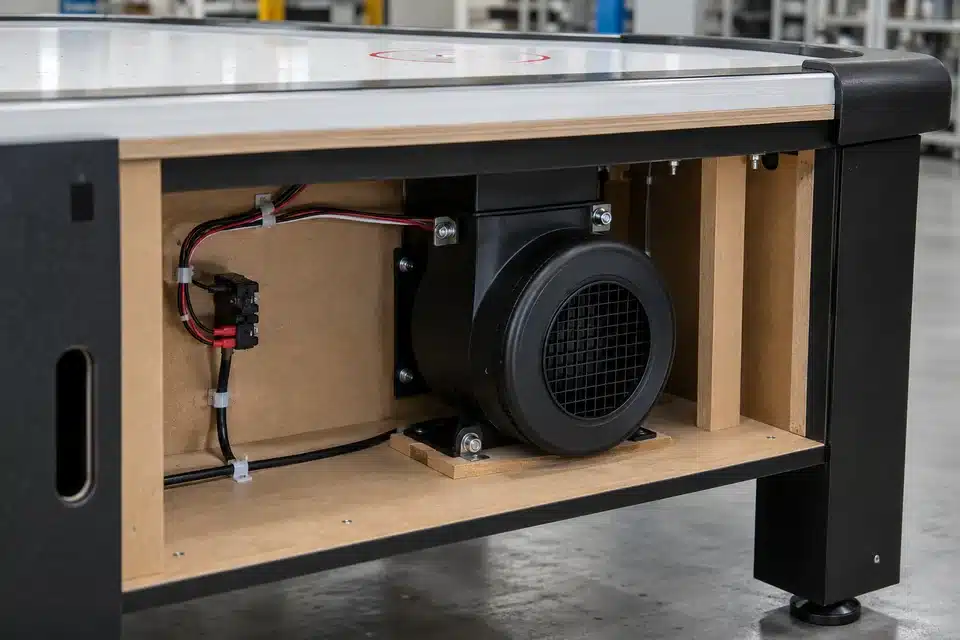
The blower creates the air cushion that reduces contact between the puck and the perforated playing surface. Buyers often ask only for motor wattage. That number is useful for electrical planning, but it does not prove that air reaches the corners and ends evenly.
A better blower review covers four questions. The acceptance criterion should focus on consistent puck movement across the complete playing field, not wattage alone.
Is airflow even across the table?
Request a continuous test video of the actual model on a level floor. The video should show puck movement through the center, corners, rails and both goal areas. Ask the supplier to disclose any test method used rather than accepting a fast promotional clip.
For sample or pre-shipment inspection, use the same puck type and repeat the same route. Record zones where the puck slows or stops. This is an operational comparison, not a laboratory airflow measurement, but it is more useful than a motor label alone.
Can the blower be serviced?
Ask how a technician reaches the blower, switch, wiring and power connection. A replaceable component is less useful if opening the cabinet damages the finish or requires removing unrelated assemblies.
Request the blower model or identification label, mounting position, access method, connector details, replacement procedure and spare-blower lead time.
Is the blower suitable for the intended duty?
A home recreation table and a table used for repeated public play may face different operating hours and service conditions. Do not infer duty rating from cabinet appearance, size or the word “commercial” in a generic listing.
Ask the supplier to confirm the intended use, recommended operating pattern, blower warranty, replacement-part availability, and cleaning and shutdown instructions in writing.
Are the playfield holes clean and open?
Dust, liquid and residue can reduce local airflow. The supplier should provide the approved cleaning method for the selected surface. Importers should also ask whether the manual permits vacuuming, compressed air or other cleaning methods; the correct procedure depends on the table construction and blower path.
Why Must Voltage, Frequency and Plug Be Confirmed Separately?
“110 V” or “220 V” is not a complete electrical specification. Importers should confirm:
- rated voltage or voltage range;
- 50 Hz or 60 Hz frequency;
- rated input power or current;
- plug and grounding arrangement;
- cord length and entry point;
- electrical label and required destination documentation;
- whether electronic scoring uses the same supply or a separate source.
The International Electrotechnical Commission publishes standardized voltage references in IEC 60038, while plug and socket systems used across IEC member countries are documented in IEC TR 60083. These references explain why destination electrical requirements cannot be reduced to one worldwide plug or voltage assumption. The buyer must still confirm applicable national rules and product requirements with a qualified local party.
A simple plug adapter does not by itself convert voltage or frequency. If the destination requires a different supply, the table should be specified with the correct blower, label, cord and plug arrangement before production.
How Should Air Hockey Tables Be Packed for Export?
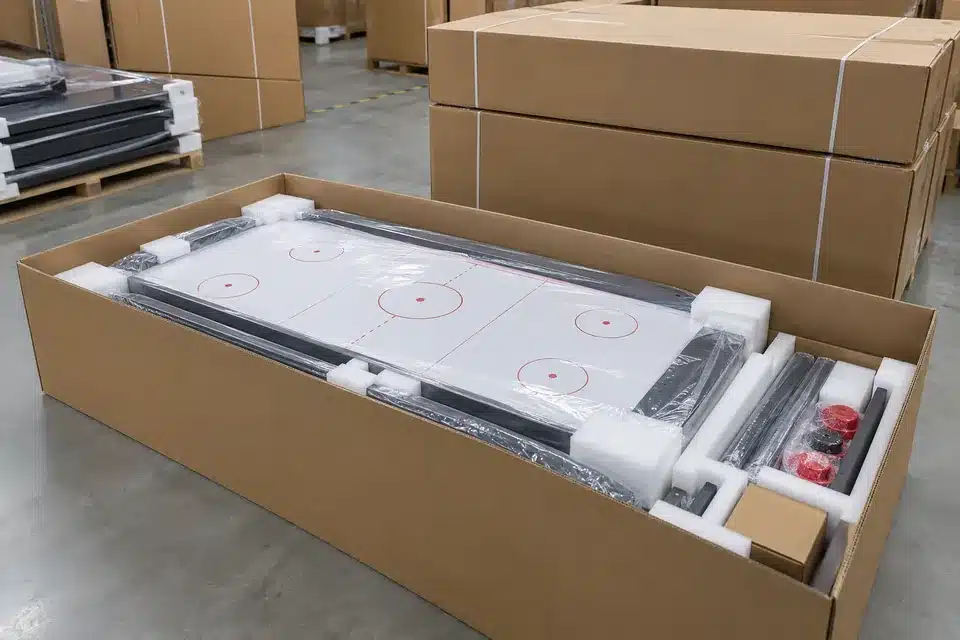
Packing must protect the cabinet, playing surface, rails, blower, wiring, accessories and finish while keeping each package identifiable.
Information required before freight calculation
Request a packing list stating the model, quantity, cartons per set, dimensions and net/gross weight of each carton, total volume and weight, accessory and spare-parts locations, carton marks, batch reference and model-specific loading basis. Request loading photos or a loading plan when required.
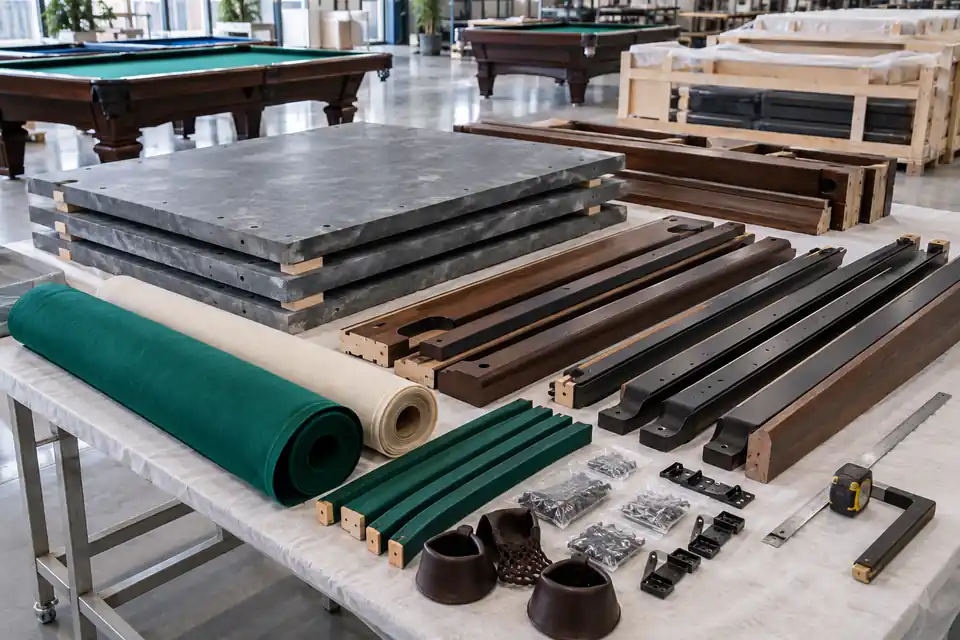
Do not assume every model is packed in one carton. Some tables may use separate cartons for legs, rails, accessories or customized parts. The final packing method should match the actual order configuration.
Protection points to inspect
A pre-shipment review should check playfield, corner and rail protection; restraint of legs and hardware; separation of pucks, strikers and scoring parts; protection of switches and cables; route-appropriate moisture protection; assembly instructions; and carton marks matching the packing list.
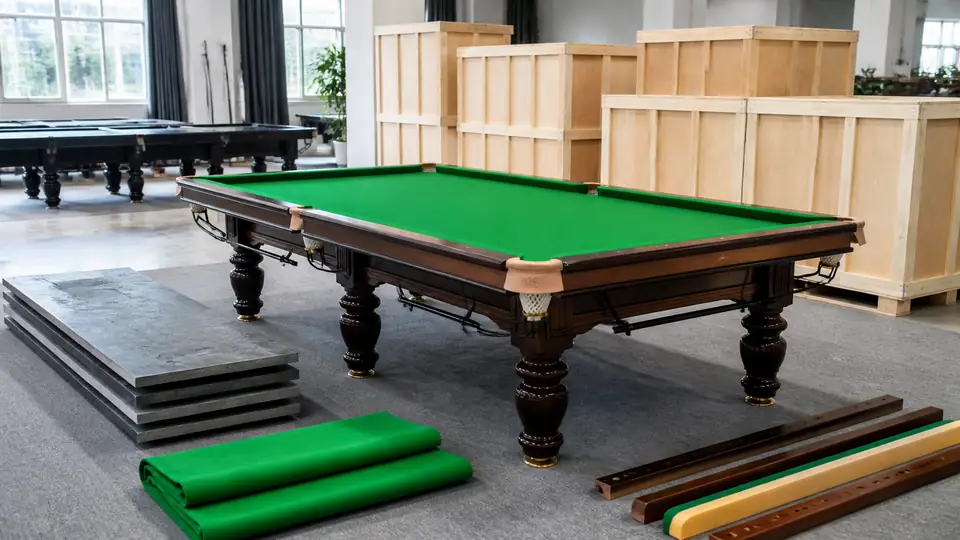
The pool-table export packaging guide covers broader shipment-planning principles that also help buyers ask better packing questions, although the final method must be confirmed for the air hockey model.
When does ISPM 15 matter?
ISPM 15 concerns regulated wood packaging material made from raw wood in international trade. The International Plant Protection Convention states that processed wood materials such as plywood are excluded from that standard’s scope. If raw-wood crates, pallets or dunnage are used, ask the freight forwarder or customs broker whether compliant treatment and marking are required for the destination. Do not assume that every carton or every plywood component needs an ISPM 15 mark. See the official IPPC ISPM 15 overview.
Can Container Quantity Be Calculated From the Carton Size?
Carton dimensions are necessary, but they do not by themselves prove how many sets fit into a container. A reliable loading plan must also consider:
- carton orientation and whether stacking is permitted;
- container internal dimensions and door opening;
- weight distribution;
- pallets, dunnage or protective gaps;
- mixed-model orders;
- loading sequence and unloading access;
- destination handling restrictions.
Ask the supplier for a model-specific loading reference and identify whether it is theoretical or based on an actual packing plan. The final packing revision should match the loading calculation.
How Do You Separate Home, Light-Commercial and Commercial Models?
There is no dependable category test based only on table length. A 6-foot cabinet may be sold for a home game room, retail assortment or commercial leisure project, but its actual suitability depends on construction and support.
For repeated public use, request written answers on:
| Decision area | What to verify |
|---|---|
| Cabinet and legs | Material, joint method, leveling points and stability |
| Playfield | Material, thickness, finish and replacement feasibility |
| Rails and goals | Impact resistance and replaceable components |
| Blower and wiring | Duty guidance, service access and spares |
| Scoring | Manual or electronic construction and replacement parts |
| Warranty | Whether the intended commercial use is covered |
| Documentation | Assembly, operation, maintenance and troubleshooting |
| Parts support | Identified components, price basis and expected availability |
If the supplier cannot confirm these points, describe the product by its verified construction and intended application rather than labeling it “commercial-grade.”
Air Hockey Table Technical Acceptance Points
Use a model-specific acceptance method rather than relying on descriptive terms such as “powerful blower” or “commercial quality.”
| Component | What to verify | Acceptable evidence |
|---|---|---|
| Playing field | Flatness, finish and open air holes | Measurement photos and a continuous puck-test video |
| Blower | Label, airflow coverage and service access | Label photo, operation video and access photo |
| Rails and goals | Condition of impact areas and replaceable parts | Close-up photos and a parts diagram |
| Scoring | Manual or electronic type and power source | Functional test video |
| Electrical system | Voltage, frequency, plug and grounding arrangement | Rating-label and plug photos |
| Noise and vibration | Blower noise and cabinet vibration | An agreed test method or continuous video |
Do not invent universal limits for airflow, noise or flatness. If measurable acceptance limits are required, the buyer and supplier should agree on the method, equipment and pass criteria before production.
What Changes the Quotation?
Quotation differences may come from the selected model, blower and electrical configuration, scoring system, accessories, branding, packing method, order quantity and destination requirements. A lower unit price is not directly comparable when these fields differ.
Before comparing suppliers, normalize the quote around:
- model and approved appearance;
- cabinet and playfield construction;
- blower quantity, voltage, frequency and plug;
- scoring and accessory package;
- packing method and carton data;
- inspection requirements;
- warranty and spare-parts responsibility;
- delivery scope and freight boundary.
What Should Be Included in the Purchase Specification?
A purchase specification should be attached to the quotation or order confirmation. At minimum, include:
- supplier and buyer names;
- exact model and approved photos;
- quantity and permitted variation, if any;
- assembled and playing-field dimensions;
- cabinet, leg, rail and playfield materials;
- blower quantity, model, electrical label and access method;
- voltage, frequency, plug, cord and scoring power;
- included pucks, strikers, scorers, hardware and tools;
- color, branding and packaging artwork;
- carton count, packed dimensions and weights;
- loading reference and destination;
- inspection method and acceptance records;
- warranty scope and exclusions;
- spare-parts list and supply responsibility;
- delivery, unloading, assembly and installation boundaries.
A supplier selection guide can help importers structure factory and documentation checks. The product category is different, but the principle remains the same: compare suppliers against evidence and a controlled specification.
Pre-Shipment Inspection Checklist
Use the approved sample or specification as the reference.
Product identity and appearance
- Verify model, quantity, color and branding.
- Check the cabinet, rails, goals and playfield for visible damage.
- Confirm fasteners, legs and levelers match the approved configuration.
Electrical and functional test
- Photograph the electrical labels.
- Match voltage, frequency, plug and cord to the order.
- Run the blower and scoring system where applicable.
- Test the switch and inspect accessible wiring.
- Check puck movement across the center, corners and goal areas.
- Record the test in one continuous video when remote inspection is used.
Dimensions and accessories
- Measure the assembled table and playing field.
- Count pucks, strikers, scorers, hardware and tools.
- Confirm instructions and part identification.
Packing
- Verify carton count, dimensions and gross weight.
- Check internal protection before sealing.
- Match carton marks to the packing list.
- Photograph sealed cartons and the loading process if included in the inspection scope.
Inspection does not replace product certification, destination compliance review or the buyer’s contract. It verifies that the finished goods match the agreed order as far as the inspection method can establish.
Common Importer Mistakes
| Mistake | Correction |
|---|---|
| Comparing only unit price | Normalize the blower, electrical, accessory, packing, spare-parts and inspection scope first. |
| Treating “6 ft” as a complete size | Record the cabinet, playing field and packed dimensions separately. |
| Requesting voltage alone | Confirm voltage, frequency, plug, grounding and input power or current. |
| Using wattage as proof of performance | Test puck movement across the complete playing field. |
| Planning freight from assembled dimensions | Use final cartons, weights and loading restrictions. |
| Calling every large table commercial-grade | Require written support for intended duty, warranty and parts. |
| Approving an incomplete specification | Close missing electrical, weight, blower and packing fields before production. |
What Should Be Sent With an Inquiry?
Send the supplier the selected model or reference image, target market, intended use, order quantity, destination, electrical requirements, scoring preference, branding, packing, spare-parts and inspection requirements. Use the purchase specification above to keep the inquiry and final order consistent.
For mixed recreation projects, the one-stop billiard and game-room solution provides a useful starting point for defining the full equipment list. Air hockey specifications must still be confirmed separately by model.
Where to Go Next
If you are sourcing air hockey tables from China, the next step is to turn this checklist into a supplier inquiry. Prepare your target size, market, voltage, plug type, order quantity, branding needs and packing requirements before asking for a quotation.
For importers who want a China-based supplier conversation, Baiyu’s air hockey table page can be used as an inquiry entry point. Send the specification fields from this guide with your request, then confirm the exact model, electrical setup, accessories, packing and inspection terms in writing before production.
FAQ
What air hockey table size should an importer choose?
Choose the size by target users, available operating space, sales channel and packed-shipment economics. Confirm both the assembled cabinet and playing field. Do not select from the nominal foot label alone.
Is a 110 V air hockey table always available?
No. A supplier must confirm the exact model, voltage range, frequency and plug for the destination market. A plug adapter does not by itself convert voltage or frequency.
Does a stronger blower always make a better air hockey table?
No. Blower input is only one factor. Even airflow across the complete playfield, hole condition, surface flatness, puck suitability and service access also affect the operating result.
How many air hockey tables fit in a shipping container?
The answer depends on the exact cartons, stacking permission, container type, weight distribution, protective materials and whether different products share the load. Ask for a packing-based loading plan.
Can a home air hockey table be used in a commercial venue?
Only when the manufacturer confirms the model is suitable for the intended duty and explains the applicable warranty, maintenance and parts support. Size and appearance alone do not establish commercial suitability.
Final Buying Rule
The safest air hockey order is built around a model-specific specification. Confirm the assembled size, playing field, blower, voltage, frequency, plug, accessories, cartons, weights, inspection method, warranty and spare parts before production approval. When any field is unpublished, treat it as a question to close, not as permission to assume.