*By Baiyu Billiards | Updated September 28, 2026*
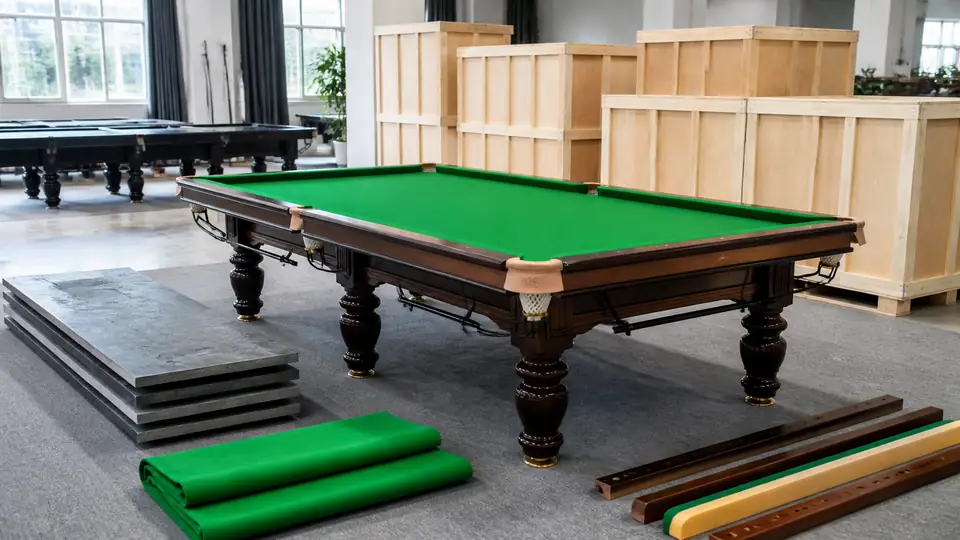
Commercial pool table shipping normally uses a component-separated, or knock-down, delivery format. For Baiyu export orders, the slate, frame or undercarriage, legs or base, rails, cloth, hardware and ordered accessories are protected and packed as separate components rather than shipped as one assembled table. This reduces the need to move a complete slate table through ports, loading bays and buildings, but it also creates a strict handover requirement: every package must remain connected to the correct order, model and table set.
Importers should therefore use three acceptance stages. Before dispatch, check the accessible components, quantities, identification and packing. On arrival, record package condition and reconcile the shipment before parts are dispersed. After destination assembly, check level, slate joints, rail fit, cushion response, cloth installation, pockets and any ball-return system. A packed table cannot pass tests that require a complete playing surface.
Key Takeaways
- A knock-down pool table is unassembled for transport; the term does not describe product quality or promise easy DIY assembly.
- Package count is not the same as table count. Each package and component group needs a traceable identity.
- Factory inspection, arrival inspection and installed-table acceptance answer different questions.
- The final packing list, approved model information and package-labeling key should agree before dispatch.
- Unloading, indoor movement, assembly, leveling and final acceptance are separate responsibilities unless the written quotation states otherwise.
- Model-specific documents and destination services must be confirmed for the order rather than assumed from a general guide.
| Acceptance stage | What can be verified | What cannot yet be confirmed |
|---|---|---|
| Before shipment | Model, quantity, accessible components, visible condition, specified dimensions, labels and packing | Final playing level, installed rail response and fitted-cloth condition |
| On arrival | Package count, external damage, moisture exposure, marks and component reconciliation during unpacking | Complete playing performance |
| After assembly | Slate joints, final level, rail fit, cushion response, cloth fitting, pockets and ball return where applicable | Items outside the agreed installation and acceptance scope |
What Does Knock-Down Pool Table Shipping Mean?
A knock-down pool table is prepared as a group of components that will be assembled at the destination. The packages form one precision playing system, so they should not be managed as unrelated pieces of furniture.
The exact breakdown depends on the model. A 9-foot American pool table, a 9-foot Chinese billiards table and a 12-foot snooker table may use different slate sets, frames, rail arrangements, pocket systems and package quantities. The approved model information and final packing list—not a generic online diagram—must control the shipment.
Shipping condition must also be separated from factory process. A supplier may perform in-process fitting or an agreed representative trial assembly, but the buyer should rely on it only when the unit, scope and evidence are identified in writing. A photograph of a different assembled table does not prove that the current order was fitted or tested together.
Component-separated shipping lets the packer protect slate, finished rails, frame members, cloth and small hardware according to their different risks. It does not by itself prove safe arrival, low freight cost or final playing performance. Detailed questions about protection, packed dimensions, weight and container planning belong in the pool table export packing guide and the order-specific packing specification.
What Components Arrive in the Shipment?
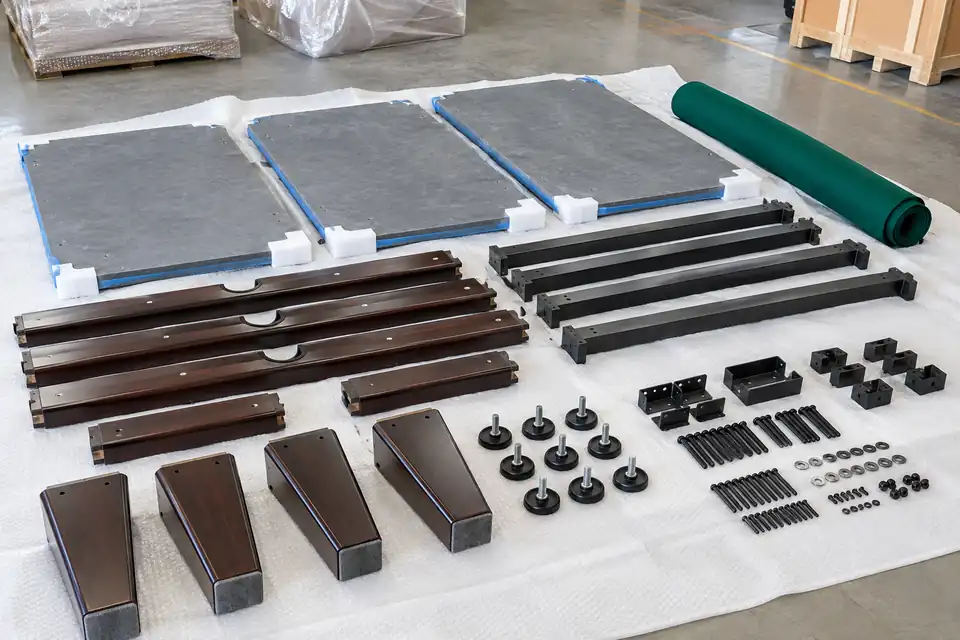
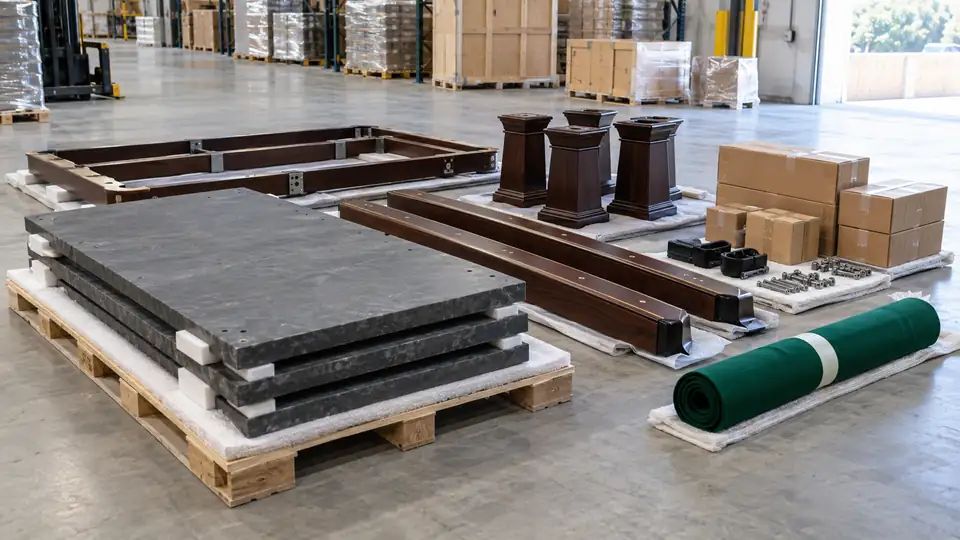
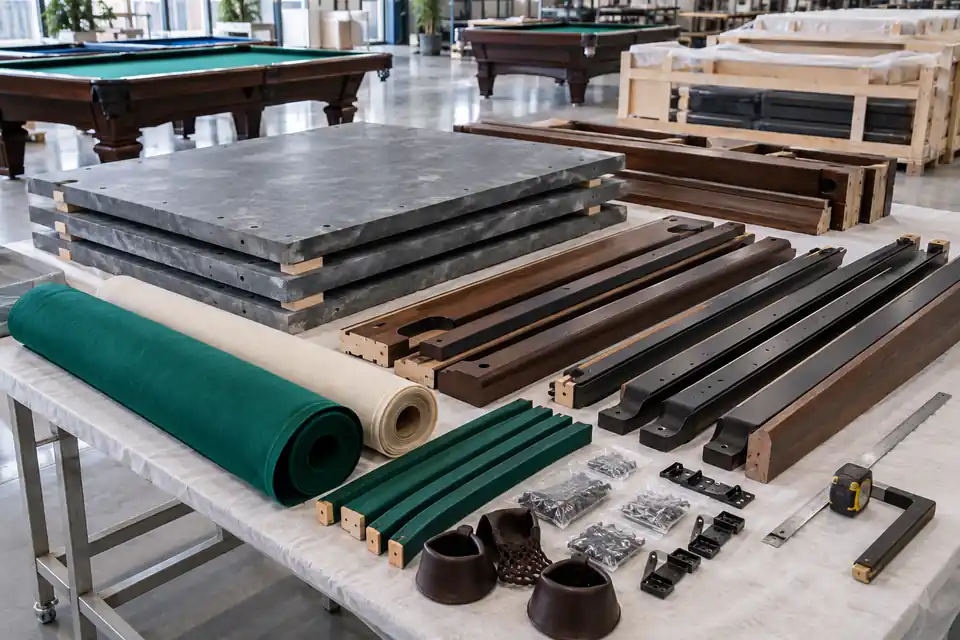
Use the final model-specific packing list because no single bill of materials applies to every pool table. A commercial slate-table shipment may contain these groups:
| Component group | Typical contents | Identification needed |
|---|---|---|
| Slate set | Individual slate pieces and model-specific support items | Model, set identity, piece count and package number |
| Frame or undercarriage | Wooden or steel members, cross-members and supports | Part identity, orientation and connection points |
| Legs or base | Legs, pedestals, base panels and levelers | Quantity, finish and leveling hardware |
| Rails and cushions | Rail sections, cushions and facings where applicable | Rail position, cushion specification and finish |
| Pocket or collection system | Pockets, liners, trays, channels or returns | System type, quantity and assembly position |
| Cloth | Bed cloth and rail cloth | Product code, color and batch or roll reference where available |
| Hardware | Bolts, brackets, plates, washers, shims and fittings | Labeled group, quantity and corresponding assembly step |
| Accessories and options | Ordered balls, cues, racks, lights, scoring equipment or other items | Exact contents, package location and electrical label where applicable |
This is a planning framework, not a promise that every order contains every item. Any substitution or model-specific difference should be identified against the approved order before shipment.
<!– IMAGE REQUIRED BEFORE PUBLICATION Purpose: Show one complete pool table component set before packing. Preferred source: Original Baiyu factory photograph from the same product category, with publication permission. Filename: commercial-pool-table-components-before-packing.webp Alt text: Slate, frame sections, rails, legs, cloth and hardware prepared for a commercial pool table shipment. Caption: The complete component set should remain traceable before it is divided into packages. Do not add unverified package counts, weights or model claims. –>
Which Documents Control the Shipment Handover?
The buyer, receiver and installer need one controlled handover pack. The document names may vary, but the information must agree with the shipped model and revision.
| Information to request | What it controls | Main user |
|---|---|---|
| Approved order or quotation | Model, quantity, finish, options and included accessories | Buyer and inspector |
| Approved model drawing or equivalent model information | Intended dimensions, structure and revision | Inspector and installer |
| Component or parts schedule | Expected major parts and model-specific systems | Inspector, receiver and installer |
| Final packing list | Package count, contents, dimensions, weights and marks | Forwarder, receiver and buyer |
| Package-labeling key or map | Relationship between packages, table sets and component groups | Receiver and installer |
| Hardware identification | Relationship between fastener groups and assembly locations | Installer |
| Assembly information | Supplier-approved sequence and model-specific requirements | Installer |
| Inspection and issue records | Observed scope, deviations, corrections and reporting status | Buyer and claims reviewer |
| Destination acceptance checklist | Checks required after unpacking and assembly | Buyer and installer |
These items are requirements to confirm, not a statement that every Baiyu order automatically includes documents under these exact names. The quotation should identify the deliverables for the selected model. The receiving team should not be expected to reconstruct a model-specific assembly sequence from sales photographs.
Use this identification chain throughout the handover:
Order → model → table or set → component group → package number.
For mixed orders, labels should distinguish formats, finishes and table sets that look similar while packed. Hardware bags and small fittings should remain connected to the relevant component group or assembly step. Accessories and spare parts need a recorded package location rather than a general note saying they are included.
How Should Packages Be Identified and Received?
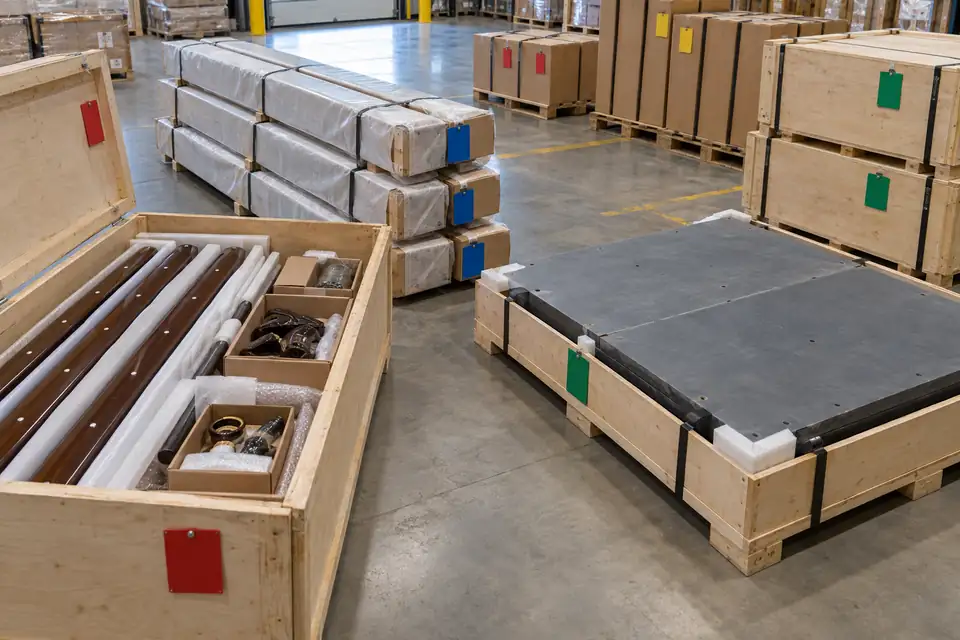
Before sealing, the agreed inspection evidence should connect the complete component group, its label, the package receiving it, the sealed package number and the corresponding packing-list entry. A barcode or QR code can support this process, but the buyer still needs a readable record if a label is damaged or the warehouse cannot access the supplier’s system.
At destination, control the handover in three steps.
1. Record Packages Before Opening
- Match the package count and marks to the transport documents and final packing list.
- Photograph all sides of wet, crushed, punctured, leaning or otherwise abnormal packages.
- Record seal condition and visible damage before packages are moved or discarded.
- Follow the applicable carrier, insurance and supplier notification procedure when an issue is found.
2. Reconcile Components During Unpacking
- Open packages in a controlled area and keep their labels visible.
- Match slate, frame members, rails, legs, cloth, hardware and accessories to the packing list.
- Photograph the complete component before taking close-up damage images.
- Keep components grouped by model and table set.
- Retain abnormal packaging until the issue has been documented and the relevant party confirms the next step.
3. Transfer a Complete Set to the Installer
The installer should acknowledge the components received or record shortages before assembly begins. This creates a clear boundary between freight receiving and installation. Without that handover, a missing part discovered later may be difficult to trace to packing, transport, storage or site handling.
<!– IMAGE REQUIRED BEFORE PUBLICATION Purpose: Show labeled packages or a redacted packing-list and package-label example. Preferred source: Real Baiyu, warehouse or installer material with publication permission and customer details removed. Filename: pool-table-package-label-packing-list.webp Alt text: Pool table package label being matched to a redacted final packing list. Caption: Package labels should connect the model, table set, component group and package number. –>
What Can Be Checked Before Dispatch?
Pre-shipment inspection should match the unassembled condition. Depending on the agreed inspection plan, the inspector may verify model, finish, quantity, accessible slate surfaces and edges, frame members, legs, levelers, rails, cushions, loose cloth, pockets, hardware, accessories and package contents before sealing. After sealing, the inspector can reconcile package marks, dimensions and gross weights with the final records.
The result must state what was actually observed. Production records may support checks on components that are no longer accessible, but they should not be described as direct inspection of a sealed package. A representative trial assembly is also not a default service; if required, its unit, method and evidence should be agreed before production.
For a component-level protocol, use the pool table pre-shipment inspection checklist. That article owns the detailed inspection topic; this guide focuses on maintaining the shipment handover from factory to destination acceptance.
What Must the Installer Verify After Assembly?
Loose components cannot prove the performance of the installed system. After assembly, the responsible installer and buyer should check:
| Installed-table item | Why it must wait | Destination evidence |
|---|---|---|
| Structural stability | Individual parts do not show all connections working under load | Completed assembly and stability record |
| Slate joints and final level | Both depend on frame setup, the actual floor and installer adjustment | Joint inspection and recorded leveling method |
| Rail fit and cushion response | Results depend on installed geometry, cloth, balls and test method | Fit inspection and agreed rebound test |
| Fitted cloth | Loose cloth cannot show installation tension, alignment or wrinkles | Bed and rail-cloth inspection |
| Pockets and ball return | Openings and collection paths depend on complete geometry | Functional test on the installed table |
| Slow-roll behavior | Ball travel reflects slate, joints, level, cloth and release method | Documented roll paths after leveling |
If an item was not tested, record Not performed—destination acceptance required rather than marking it passed. A factory trial assembly, when specifically agreed, provides preliminary evidence for the identified unit; it does not replace installation and leveling on the destination floor.
The installer should receive the model information, parts identification and acceptance method before delivery. The buyer should also check the route using the largest, longest and heaviest relevant package—not only the assembled table dimensions. Review the unloading point, doors, turns, stairs, elevators, floor protection and staging area. For a multi-table venue, complete dusty construction, flooring, overhead lighting and electrical work before final leveling whenever practical.
Who Is Responsible for Unloading, Assembly and Acceptance?
“Delivery included” is not a complete responsibility schedule. Confirm each activity in writing:
| Activity | Party to identify | Scope to confirm |
|---|---|---|
| Factory preparation and packing | Supplier or contracted packer | Approved model, components, marks and final packing list |
| Pre-shipment inspection | Factory, buyer, agent or independent inspector | Scope, evidence, deviations and release decision |
| International and destination transport | Party named in the quotation and transport documents | Delivery point, handling scope and notification process |
| Unloading and indoor movement | Buyer, carrier or specialist contractor | Labor, equipment, access, staging and damage record |
| Assembly and leveling | Qualified local installer or expressly contracted team | Model experience, tools, consumables and acceptance method |
| Electrical work | Qualified local contractor where required | Local compliance and final testing |
| Final acceptance | Buyer’s authorized representative with the installer | Completed checklist and unresolved issues |
The allocation is contractual. Do not assume the freight carrier provides indoor movement or specialist installation. Likewise, do not assume Baiyu provides destination installation unless it is included in the written quotation for that order.
What Should an Importer Confirm Before Ordering?
Send the supplier the table format and model reference, quantity, destination, intended use, room and access information, finish, cloth, accessories, optional systems, inspection arrangement and local installer plan. Request the current component, packing and service information for that exact order.
Avoid these common mistakes:
| Mistake | Better control |
|---|---|
| Counting crates but not components | Reconcile package numbers, component groups and table sets |
| Treating the shipment as ordinary furniture | Arrange controlled heavy-component handling and qualified installation |
| Sending documents after delivery | Give the receiver and installer the handover pack in advance |
| Treating factory inspection as final performance acceptance | Reserve assembly-dependent checks for the installed table |
| Mixing parts from several tables | Preserve model and table-set identity through staging and assembly |
| Discarding packaging before reporting an issue | Record the package and follow the written notification procedure first |
Buyers still comparing factories can use the pool table supplier selection guide. For a multi-table venue, the billiard room solution can help define the product mix, while destination handling and local building work remain separate unless written into the scope.
To request model-specific information, contact Baiyu with the table model, quantity, destination, site-access conditions and installer plan. Ask for the current packing and handover scope in writing before approving the order.
FAQ
Are Commercial Pool Tables Shipped Fully Assembled?
No. Baiyu export pool tables are shipped as separately packed components, including the slate, frame or base, rails, cloth, hardware and ordered accessories. The exact breakdown and package quantity depend on the selected model and order.
Can the Buyer Assemble a Pool Table Without a Specialist Installer?
Knock-down describes the shipping condition; it does not guarantee simple DIY assembly. Slate handling, frame setup, slate-joint work, cloth fitting and final leveling may require an installer familiar with the selected table format.
Which Documents Should Accompany the Shipment?
The buyer should confirm a handover pack that identifies the approved model, components, packages and applicable assembly and acceptance information. Exact document names and deliverables must be agreed for the order.
Which Checks Must Wait Until Destination Assembly?
Final level, slate joints, installed rail fit, cushion response, fitted cloth, pocket behavior, ball return and slow-roll performance depend on the assembled table and destination floor. They cannot be passed from packed components alone.
Who Handles Unloading, Installation and Final Acceptance?
The quotation or contract must identify the responsible parties. International freight, unloading, indoor movement, storage, assembly, leveling, electrical work and final acceptance are separate activities unless the written scope combines them.
Final Handover Rule
Manage an unassembled commercial pool table as a traceable component system, not a collection of crates. Approve the model and document scope before production, inspect the accessible components and packing before dispatch, preserve package-to-component identity during receiving, and reserve assembly-dependent acceptance for the installed table at the destination.