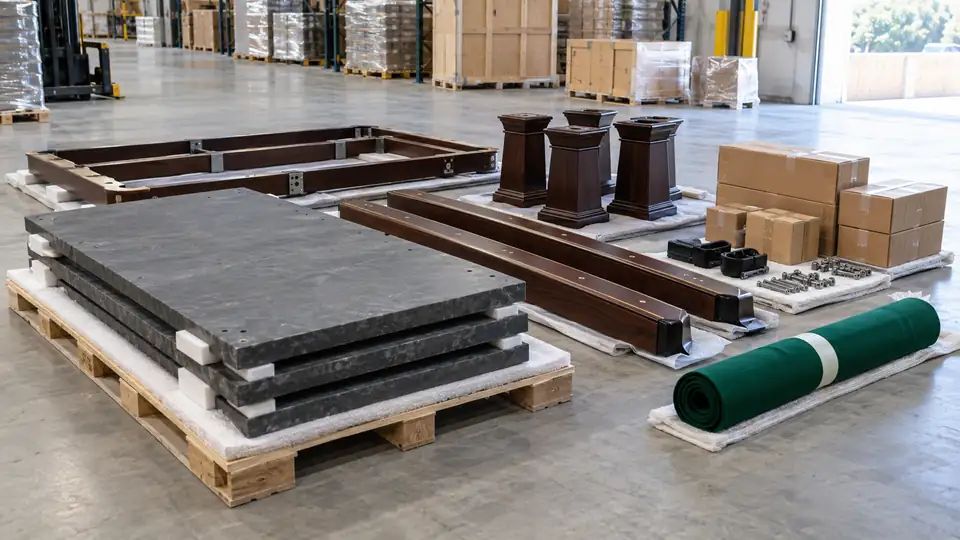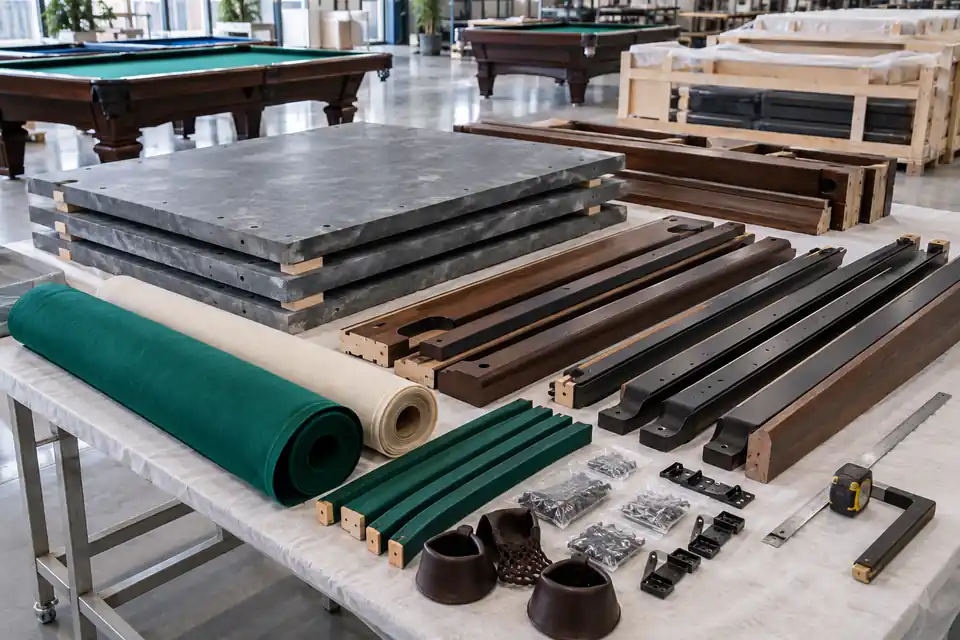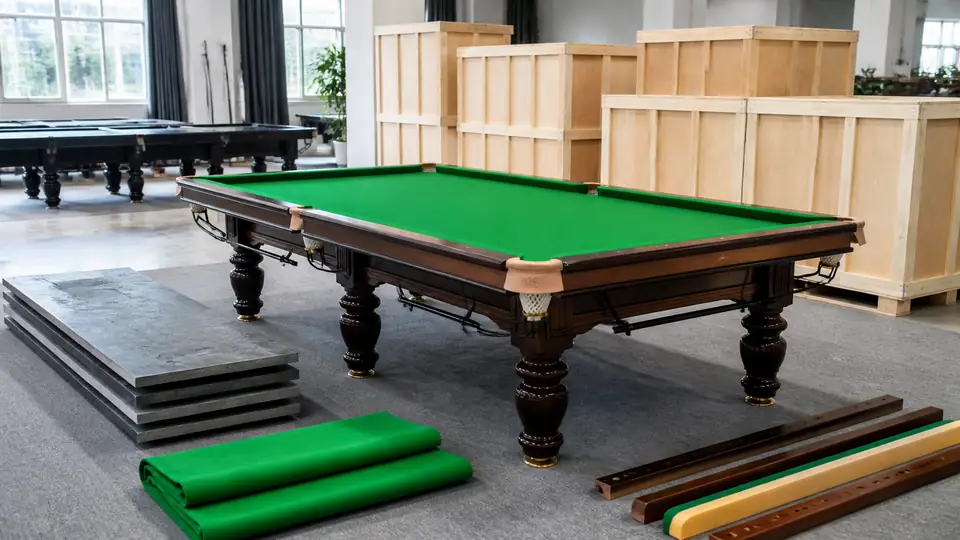
A pool table order should be inspected against the approved purchase specification, drawing, component schedule and packing requirements—not photographs or phrases such as “professional quality.” Baiyu tables are shipped unassembled, with slate, frame sections, rails, legs, cloth, hardware and accessories packed as separate components. The final pre-shipment inspection (PSI) must therefore focus on component identity, quantity, dimensions, workmanship, completeness and packing. Whole-table leveling, slow-roll, cushion-rebound, pocket and ball-return tests are possible only if a representative table was separately assembled before dismantling. If no trial assembly was agreed, record those tests as not performed and complete them after destination assembly. In-process records are still needed for details that become hidden during component manufacture or packing.
Key Takeaways
- Freeze the criteria, defect classes, coverage and release authority before production.
- Inspect hidden details in process; use the final PSI for loose components, counts, condition and packing.
- Verify cushions and cloth against traceable labels, samples and the approved component schedule.
- Treat whole-table playing tests as optional checks that require separately agreed trial assembly.
- Reconcile every package and record who must approve corrections or deviations before shipment.
What Documents Must Control the Inspection?
Use one controlled inspection pack. Conflicting quotations, drawings or messages must be resolved before inspection.
| Control document | What it should identify | Inspection use |
|---|---|---|
| Purchase order or signed quotation | Model, quantity, finish, included accessories and commercial scope | Confirms what was purchased |
| Approved drawing | Playing surface, overall dimensions, height, pockets, frame and revision number | Controls dimensional checks |
| Component schedule | Slate, cushions, cloth, pockets, levelers, hardware and optional systems | Detects substitutions and omissions |
| Approved sample or finish reference | Color, texture, logo position and visible workmanship | Controls appearance checks |
| Inspection plan | Items, instruments, sample size, evidence and acceptance criteria | Defines how results are judged |
| Defect and coverage plan | Critical, major and minor defects; full-check and sampled items | Prevents improvised decisions at the factory |
| Packing specification | Package construction, count, markings, dimensions and protection | Controls shipment preparation |
| Release procedure | Corrective-action, deviation-approval and shipment-release authority | Identifies who may close an issue |
Replace vague grades with measurable descriptions. Before booking, provide the order, destination, production status, substitution rules, instruments, test methods, evidence format and reinspection procedure.
Which Checks Need Full or Broader Inspection Coverage?
Coverage must follow the contract and order risk. Sampling may be suitable for repetitive cosmetic checks, but the buyer and supplier must agree on the plan and defect classification before inspection. If an Acceptable Quality Limit (AQL) plan is used, name the standard, lot size, inspection level, sample size and acceptance numbers; do not copy a generic AQL value from another product category.
Consider broader coverage for high-risk checks:
- Identity and quantity of tables and major packages.
- Slate identity and visible damage before packing.
- Electrical labels and plugs on powered options.
- Accessory and hardware sets.
- Component-set coverage of every model and configuration; representative trial assembly only when contracted.
These are planning priorities, not a universal mandatory full-inspection rule. The approved inspection plan must state which items receive complete, broader or sampled coverage.
How Should the Inspection Be Staged?
The inspection schedule should follow the points at which components become hidden.
| Inspection point | Main checks | Evidence to retain |
|---|---|---|
| In-process, before packing | Slate identity and condition; frame structure; cushion and cloth identity | Full-component photos, labels and measurements |
| Optional trial assembly | Rail fit, supports, levelers, overall dimensions and playing tests, only when agreed in advance | Assembly overview, results and dismantling record |
| Final PSI of loose components | Finished quantity, component identity, appearance, selected dimensions and completeness | Component IDs, measurements and count sheet |
| Before packing is sealed | Component separation, restraint, accessories, documents and marks | Open-package photos and packing checklist |
| After sealing | Package count, dimensions, gross weights and labels | Final packing list, scale photos and package overview |
Before the visit, confirm completed quantity, component and packing lists, hidden-process records, an open packing set, safe access, and staff for correction and repacking. If trial assembly was contracted, confirm the model, timing, test balls, power where applicable, dismantling plan and retained evidence. Agreed instruments must have identifiable calibration status.
Inspection tools and their limits
| Tool | Typical use | Important limit |
|---|---|---|
| Tape measure | Overall and package dimensions | Not suitable for tight component tolerances |
| Caliper or micrometer | Slate or component thickness | Contact point and instrument range must be defined |
| Straightedge and feeler gauge | Local gaps and joint checks | Result depends on straightedge length and stated locations |
| Precision level | Optional trial-assembly level readings | Cannot test a dismantled table; level does not prove local flatness |
| Calibrated scale | Gross package weight | Check capacity, zero and calibration status |
| Clean reference balls | Optional trial-assembly playing tests | Cannot test loose components; ball condition and release method affect results |
How Should the Slate Be Inspected?
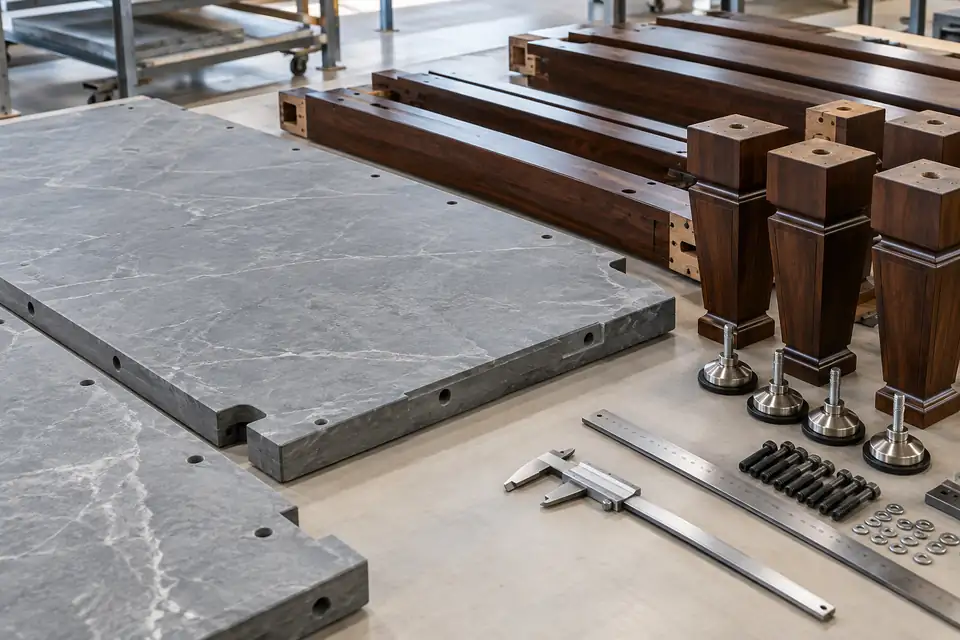
Inspect material identity, dimensions and surface condition on every accessible slate piece. Joint alignment, installed flatness and overall level require dry fitting or trial assembly and cannot be confirmed from separately packed slate alone.
Before cloth installation
- Match the slate set and piece count to the approved model.
- Photograph faces, edges, pocket cuts, holes and piece IDs.
- Measure thickness with the stated instrument and locations.
- Record cracks, chips, repairs and incomplete machining.
- If dry fitting was agreed, inspect joints and support contact; otherwise record these as destination checks.
Defect rules should distinguish repairable edge appearance from structural or playing-surface risks.
Flatness and joint checks
Flatness describes the surface; level describes its position relative to gravity. Loose slate can be checked for accessible local surface defects, but final joint condition and level must be assessed on a supported, assembled bed.
Specify the instrument, grid, direction, support condition and limit. Record its resolution and calibration status. For a straightedge and feeler gauge, state the straightedge length and measurement locations.
The WPA Recommended Equipment Specifications require at least 25.4 mm slate for the pool tables covered by that document. They also state overall flatness limits of 0.508 mm lengthwise and 0.254 mm across the width, with leveled and shimmed slate joints in the same plane within 0.127 mm. These figures apply to the WPA event-equipment context described in the document; they are not automatic acceptance limits for every commercial, recreational, Heyball or snooker table.
Do not reproduce the WPA concentrated-load test unless the contract requires it and an approved safe method is available.
<!– IMAGE REQUIRED BEFORE PUBLICATION Purpose: Show a real slate inspection before cloth installation. Preferred source: Original factory inspection photograph with permission to publish. Alt text: Inspector checking pool table slate surface and joint before cloth installation. Caption: Slate condition should be documented before packing; joint alignment requires an agreed dry fit or assembled bed. Do not add an unverified tolerance or test result to the image. –>
What Should Be Checked on the Frame, Base and Legs?
The frame must support the slate as defined by the approved drawing.
Check:
- model, material, finish and support layout;
- legs, attachment hardware, welds, joints and visible damage;
- number, position and access of leveling points;
- component alignment against drawings; assembled stability only when trial assembly was agreed;
- clearance for returns, heating, lighting or wiring where included.
Fastener torque should follow the manufacturer’s documented assembly requirement. Do not invent one universal torque value for different wood, metal and composite structures.
Confirm that assembly instructions and identified hardware are included. If no trial assembly was agreed, do not mark rail fit, stability or overall level as passed; assign them to destination acceptance.
<!– IMAGE REQUIRED BEFORE PUBLICATION Purpose: Show unassembled frame, legs, levelers and hardware laid out for component verification. Preferred source: Original factory inspection photograph with permission to publish. Alt text: Unassembled pool table frame components, legs, levelers and hardware checked before packing. Do not imply that component inspection verifies assembled stability or level. –>
How Should Cushions, Rails and Pockets Be Verified?
On loose rail components, verify the rubber identity, profile, bonding, straightness, facings and rail workmanship. Installed cushion-nose height and complete pocket geometry require assembly.
Component checks
- Match the cushion label and profile to the component schedule.
- Inspect bonding, straightness, joints, deformation and pocket facings.
- Check rail and pocket-part dimensions only where the order defines a loose-component method and limits.
- Confirm rail bolts and destination-assembly hardware.
For tables explicitly ordered to the covered WPA pool specification, the document places the installed cushion nose at 62.5%–64.5% of ball diameter above the bed. This cannot be verified from a separately packed rail without a defined fixture or assembled table.
When is a functional cushion test possible?
Only perform rebound testing on a separately agreed trial-assembled table. The WPA method places the ball on the head spot and shoots it through the foot spot with center-ball contact, a level cue and a firm stroke; the ball must travel at least four to four-and-a-half table lengths without jumping. This applies only to the WPA pool-equipment context and controlled test conditions, not automatically to snooker or Heyball tables.
If the order is inspected only as loose components, mark cushion rebound, installed nose height and complete pocket geometry as not tested before shipment. Check them after destination assembly.
How Should Pool Table Cloth Be Inspected?
For component-separated shipment, verify the cloth before cutting or packing. Fitted-cloth checks apply only to a contracted trial-assembly unit or to destination acceptance.
Before cutting
Confirm:
- brand, product code and roll or batch identification;
- color against the approved sample under consistent lighting;
- construction, composition and nap direction where specified;
- width and quantity for the bed and rails;
- absence of stains, holes, pulls, creases or visible shade variation;
- storage condition and supplier-approved handling instructions.
Do not rely on color names or screens; use an approved physical sample or traceable product code.
If cloth is fitted to a trial-assembly unit
Inspect tension, alignment, wrinkles, loose areas, damaged fibers and pocket folds. Confirm nap direction only for directional cloth. Otherwise, record these as destination-installation checks.
The WPA pool specification calls for non-directional, nap-free cloth for its covered competition tables and provides installation guidance. That requirement does not define cloth for snooker, Heyball or every commercial venue. The selected game format and approved cloth specification must control the inspection.
Which Checks Must Wait Until Destination Assembly?
For a component-separated shipment, the final PSI cannot pass whole-table level, joint performance, rail fit, installed cushion height, rebound, fitted-cloth condition, pocket performance or ball-return travel. Put these items on the destination acceptance checklist. If the order separately includes representative factory trial assembly, the following tests provide preliminary evidence only; identify the model and component IDs, then record the setup, test method and dismantling.
Optional trial-assembly level and slow-roll checks
- Use the agreed level or flatness method.
- Release clean balls along documented lengthwise, crosswise and diagonal paths.
- Cross slate joints and test near rails and pockets.
- Repeat drift and record the support and leveling condition.
A slow-roll test evaluates the assembled system, not slate alone; cloth, balls, contamination, joints and release method affect the result.
Optional trial-assembly rail, pocket and return checks
- Test cushion response from multiple documented positions.
- Confirm pocketed balls enter without striking an obvious obstruction.
- Check drop-pocket capacity or ball-return travel where applicable.
- Listen for loose components, repeated vibration or abnormal impact noise.
- Confirm that scoring, lighting, heaters or other powered options operate when included.
Even after a factory trial, the destination installer must assemble, level and test the table again on the actual floor.
How Should Finish, Branding and Accessories Be Checked?
Match visible features to the approved sample and order.
Verify:
- finish, logo, sights, counters, nameplates and trim;
- pockets, trays or return parts;
- ordered balls, cues, racks, rests, brushes and covers;
- tools, fasteners, shims, consumables and identified spare parts;
- assembly, operation and maintenance instructions.
Count accessories by set and by package. “Accessories included” is not sufficient for inspection or later shortage claims.
How Should Export Packing Be Inspected?
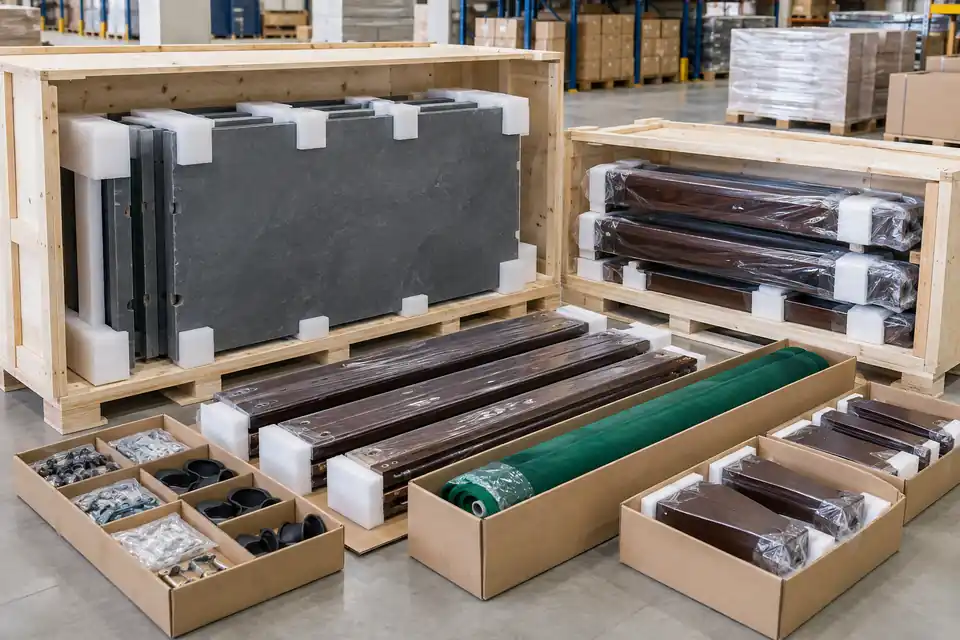
Inspect internal protection before sealing; a closed crate reveals only its exterior.
Internal protection
Check separation, cushioning, edge protection, moisture control and restraint. Slate must not strike rails or loose hardware. Use the approved orientation and support method.
Package data and markings
Reconcile:
- packages per table and total package count;
- contents, dimensions and gross weight;
- handling, orientation and destination marks where required;
- model, order and package number;
- accessory and spare-parts location;
- photographs before and after sealing;
- final packing list and loading plan.
The Baiyu pool table export packaging guide illustrates common separation and protection considerations. It is a planning reference, not the authority for phytosanitary compliance. The final method must match the selected model, route and approved packing specification; official IPPC rules and destination requirements control regulated wood packaging.
Raw-wood packaging and ISPM 15
ISPM 15 covers regulated raw-wood packaging and dunnage in international trade. The International Plant Protection Convention excludes processed wood such as plywood when processing makes it pest-free. Confirm the crate, pallet and dunnage materials, then verify treatment, marking and destination documents with the freight forwarder or customs broker. Do not assume every plywood panel needs an ISPM 15 mark. See the official IPPC ISPM 15 overview.
<!– IMAGE REQUIRED BEFORE PUBLICATION Purpose: Show internal pool table packing before the crate is sealed. Preferred source: Original export-packing photograph with permission to publish. Alt text: Pool table slate, rails and hardware separated and protected for export packing. Caption: Internal separation and restraint should be inspected before exterior sealing hides the components. Do not describe a package as ISPM 15 compliant unless the actual material and markings are verified. –>
What Evidence Should the Inspector Deliver?
A large folder of unlabelled photographs is not an inspection report. Evidence must connect each finding to the correct model, table, component and package.
The report should show the order and revision, inspected quantity and coverage, component/package identifiers, instruments and calibration status, and each deviation’s severity and controlling requirement. Photographs must show the complete component before close-ups; measurement images must show both location and reading. If trial assembly was contracted, identify that unit and retain continuous video for relevant assembly or functional checks. Include correction evidence, reinspection results and the final package reconciliation.
Time stamps can help organize evidence, but a time stamp alone does not prove that the image belongs to the inspected order. Include the order or inspection identifier in the scene where practical.
How Should Failed Items Be Handled?
Use three clear outcomes:
| Outcome | Meaning | Shipment decision |
|---|---|---|
| Pass | The inspected scope meets the approved criteria | Shipment may proceed subject to other contractual requirements |
| Conditional acceptance | A documented deviation is accepted by an authorized buyer representative | Retain written approval and any price, warranty or replacement condition |
| Fail or hold | A critical requirement is not met or evidence is incomplete | Correct and reinspect before release |
The supplier may propose repair, replacement, rework or concession, but only the contractually authorized buyer representative may accept it. Hold shipment for wrong slate, unresolved cracks, unsafe electrical configuration, missing major components or inadequate load restraint until correction is verified.
Factory Inspection or Third-Party Inspection?
Choose factory, buyer-appointed or independent inspection according to order value, complexity, supplier history, destination risk and the buyer’s quality system.
| Method | Best use | Limitation |
|---|---|---|
| Factory self-inspection | Routine production records and correction before external review | The producer is checking its own work |
| Live video inspection | Remote component identity, appearance, counts and selected measurements | Camera framing and measurement control are limited |
| Buyer or agent visit | Direct review by a party familiar with the order | Requires travel, access and technical preparation |
| Independent inspection company | Documented checks against a buyer-issued protocol | Quality depends on the clarity of the protocol and inspector competence |
Third-party inspectors still need the controlled documents, methods and acceptance criteria before the visit.
Master Inspection Sign-Off Checklist
Use one sign-off sheet to connect the approved requirement, result and evidence. Add model- or order-specific rows as needed.
| Inspection item | Requirement | Method | Result | Evidence ID | Corrective action |
|---|---|---|---|---|---|
| Model and quantity | Approved order and drawing | Identity and count check | Pass / Hold | ||
| Slate | Component schedule and stated tolerances | Identity, visual and agreed measurement checks | Pass / Hold | ||
| Frame and levelers | Approved drawing and parts list | Loose-component identity, visual and dimensional checks | Pass / Hold | ||
| Cushions and pockets | Approved profile and parts geometry | Label, bonding, workmanship and loose-part checks | Pass / Hold | ||
| Cloth | Approved product code or sample | Roll label, quantity, color and loose-cloth condition | Pass / Hold | ||
| Optional trial assembly | Approved trial and test procedure | Fit, level, slow-roll, rebound, pocket and return checks | Pass / Hold / Not performed | ||
| Accessories | Approved packing list | Set and package count | Pass / Hold | ||
| Export packing | Approved packing specification | Open- and sealed-package checks | Pass / Hold |
Every hold item needs an owner, due date, correction evidence and release decision. The inspector records the result; only the person authorized by the contract may accept a deviation or release the shipment.
Buyers comparing manufacturers can use the pool table supplier selection guide before inspection. For model selection, review the relevant American pool table, Chinese billiards or snooker table category, then attach the final model-specific documents to the inspection order.
Request a Model-Specific Inspection Pack
For a Baiyu order, send the model, quantity, destination, approved configuration and inspection method before production is completed. Request the latest drawing, component schedule, packing information and available evidence for the exact order. Inspection arrangements depend on the agreed project scope.
The buyer defines the standard, appoints a qualified inspector where needed, reviews deviations and approves shipment. Destination unloading, indoor movement, assembly, final leveling, electrical work and local compliance remain separate unless the contract says otherwise.
FAQ
Can pre-shipment inspection prove that a pool table will be level after installation?
No. The destination floor, assembly and installer workmanship determine the final result. Level and accept the table on site.
Should the cloth be installed before inspection?
Inspect the loose cloth and slate before packing. Fitted-cloth and playing checks require a separately agreed trial-assembly unit; otherwise complete them at the destination.
How many pool tables should be inspected?
Follow the agreed coverage plan. Represent every model and configuration; apply broader or complete coverage to specified high-risk items.
Is a ball-roll test enough to approve the slate?
No. It is available only on an assembled table and is affected by cloth, balls, contamination and release method. For a component shipment, complete it after destination assembly unless a factory trial was contracted.
Does third-party inspection replace the supplier warranty?
No. Inspection records a defined scope at one time. Warranty, freight damage, destination installation and service remain governed by separate written terms.
Final Inspection Rule
Do not release a component-separated pool table order because a few parts look correct in photographs. Release it when the models, slate sets, frame and rail components, cloth, hardware, accessories and packages are traceable to the approved documents, and every shipment-blocking deviation has been corrected or formally accepted. Clearly mark assembly-dependent checks as either completed on an agreed trial unit or deferred to destination acceptance.
References
- World Pool-Billiard Association Recommended Equipment Specifications, effective November 2001. Used only for the WPA competition-equipment references identified in the article. Accessed September 13, 2026.
- IPPC ISPM 15: Regulation of Wood Packaging Material in International Trade. Used for the raw-wood packaging scope and processed-wood exclusion. Accessed September 13, 2026.
- About Baiyu. Used for the manufacturer location stated in the introduction. Accessed September 13, 2026.