There is no reliable single answer to “How much does a Chinese pool table cost?” until the buyer defines the table specification and delivery boundary. Two quotations can show very different prices while both being commercially reasonable because one may include heavier slate, a stronger frame, branded cloth, accessories, reinforced export packing, or delivery to the destination. The other may cover only the table made available at the factory.
Importers should compare seven factors before comparing the final number: slate, frame, cloth, configuration, packaging, quantity, and trade terms. The safest method is to normalize every offer to the same specification and then calculate its total landed cost.
Key Takeaways
- A Chinese pool table’s quoted price is not the same as its landed or installed cost.
- Product photographs do not reveal slate grade, structural support, cloth, pocket construction or packing quality.
- Every supplier should quote against the same written configuration.
- Packaging volume and gross weight can affect freight as much as the table’s unit price.
- A lower EXW quotation is not automatically cheaper than an FCA, CIF, DAP or DDP offer.
- The named place must be written after the selected Incoterms rule.
- Import duty, tax, unloading and installation should be confirmed separately rather than assumed.
What Does “Chinese Pool Table Cost” Include?
Importers should distinguish three cost levels.
1. Factory product cost
This covers the table and whatever components the supplier has included in the quoted configuration. Depending on the offer, it may or may not include accessories, export packing or loading.
2. Landed cost
Landed cost is the amount required to move the order from the supplier to the agreed destination, including the applicable logistics and import charges.
A practical comparison formula is:
Landed cost = product price + optional upgrades + export packing + origin handling + international freight + cargo insurance + import duty and tax + destination charges + final delivery
The exact items paid by the seller or buyer depend on the sales contract and the selected Incoterms rule.
3. Installed operating cost
A pool table may still require local handling and installation after delivery. Installed cost can include:
- unloading;
- moving crates into the venue;
- slate handling;
- table assembly;
- levelling;
- cloth installation;
- lighting installation;
- packaging disposal;
- replacement parts or spare consumables.
For a commercial billiards venue, the installed operating cost is usually a more useful decision figure than the factory unit price.
Why Headline Price Is Not Enough
Two pool tables can look almost identical in online photographs while having different internal structures and quotation scopes.
A lower headline price may result from:
- different slate material or thickness;
- fewer or lighter structural supports;
- unbranded or substituted cloth;
- a simpler pocket or cushion system;
- fewer accessories;
- lighter export packing;
- a smaller quantity basis;
- an earlier delivery boundary.
The buyer cannot determine these differences from a product name such as “9-foot commercial pool table.” The quotation must identify the exact technical and commercial scope.
1. Slate Specification
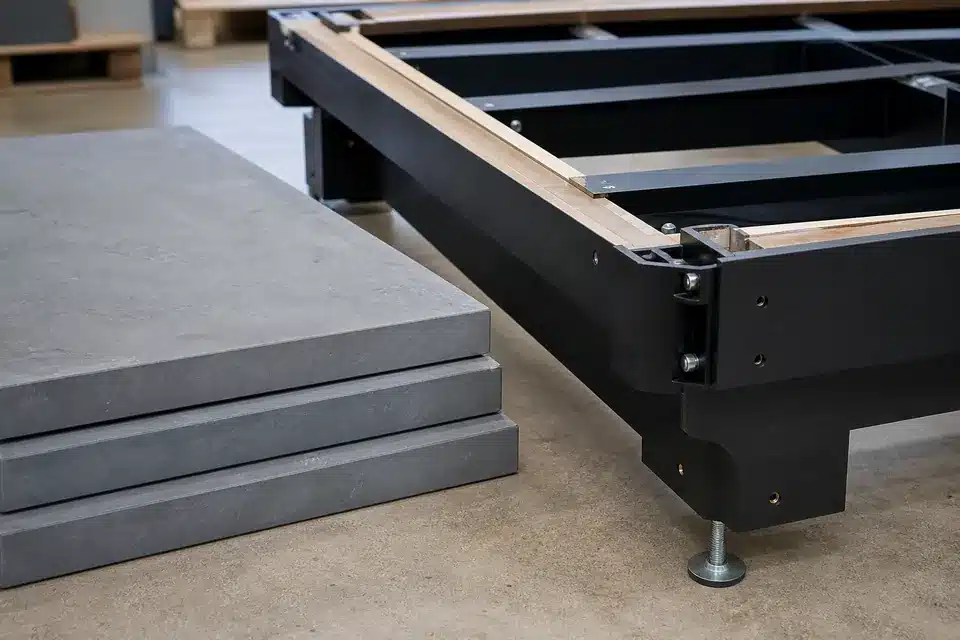
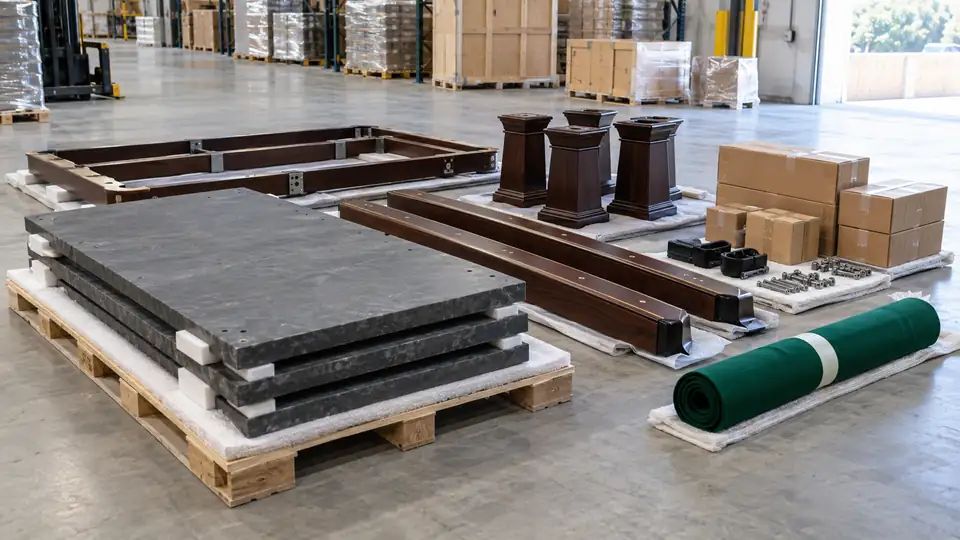
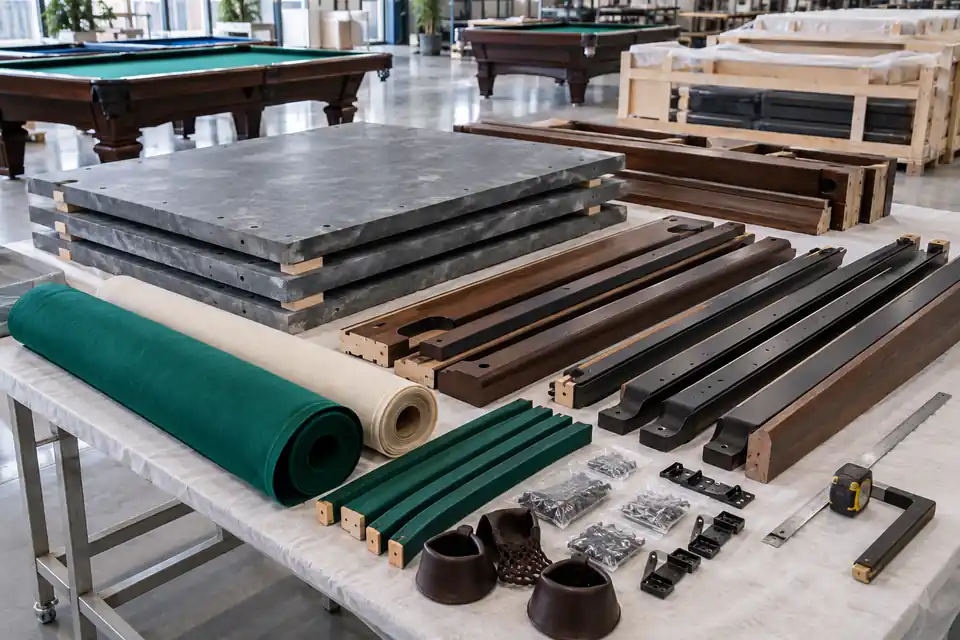
Slate affects material cost, total weight, packing design, freight and installation requirements. Buyers should request:
- slate material or stated origin;
- number of sections;
- finished thickness;
- dimensions of each section;
- grade or inspection criteria;
- joint arrangement;
- support and fastening method;
- gross slate weight, if available.
A thicker slate can cost more and increase freight, but thickness alone does not prove that one table will perform better. Flatness, machining, joint preparation, frame support and installation all matter.
For comparison, the WPA Recommended Equipment Specifications require slate at least 25.4 mm thick for the competition tables covered by that document and specify three equal slate sections for tournament tables.[[1]](https://wpapool.com/wp-content/uploads/2024/01/RECOMMENDED-EQUIPMENT-SPECIFICATIONS.pdf) This is a WPA competition reference, not a universal requirement for every commercial or Chinese-made pool table.
The buying rule is straightforward:
Do not compare pool table prices until every supplier has written the slate specification into the quotation.
2. Frame and Levelling Structure
The frame or undercarriage carries the slate and helps the table remain level after shipping and installation.
Frame-related price differences may come from:
- steel, solid timber or composite construction;
- beam layout;
- material section and thickness;
- number of slate-support points;
- leg design;
- fasteners and connections;
- levelling hardware;
- decorative components versus load-bearing components.
The WPA equipment reference evaluates slate flatness together with the table’s supporting base frame, illustrating why the slate and frame should not be judged separately.
Ask each supplier for a frame drawing or clear underside photographs. A decorative exterior does not reveal how the slate is actually supported.
The quotation should also state where the adjustment points are located, how the table is levelled, which tools are needed, and whether re-levelling is possible after installation.
3. Cloth Specification
Cloth changes the product price, playing characteristics and later replacement cost. A quotation that says only “professional cloth” is not specific enough for comparison.
Ask for:
- cloth brand;
- model or product series;
- material or cloth category;
- colour;
- whether it is installed or packed separately;
- whether rail cloth is included;
- whether spare cloth is included;
- whether substitutions require written approval.
For a multi-table billiards club, consistency matters. A small saving on mixed or unspecified cloth may create differences in speed, colour and replacement planning across the venue.
Cloth cost should therefore be evaluated as both an initial purchase item and a future maintenance item.
4. Table Configuration and Accessories
“Standard configuration” has no useful commercial meaning unless the supplier provides a component list.
Configuration differences may include:
- cushion brand, profile or material;
- pocket mouth and shelf design;
- pocket plates, leather components or nets;
- rail material and finish;
- ball-return or drop-pocket system;
- balls;
- playing cues;
- break cues;
- bridge cues and rests;
- cue rack;
- table cover;
- triangle or template rack;
- chalk, tips, glue and brushes;
- table lighting;
- spare cloth, pockets or levelling parts.
Buyers should ask:
Is this price for the table body only, or for the complete package listed in the attachment?
Every accessory should have a description and quantity. If a supplier offers an upgrade, request a separate price line rather than allowing the entire configuration to change.
5. Export Packaging
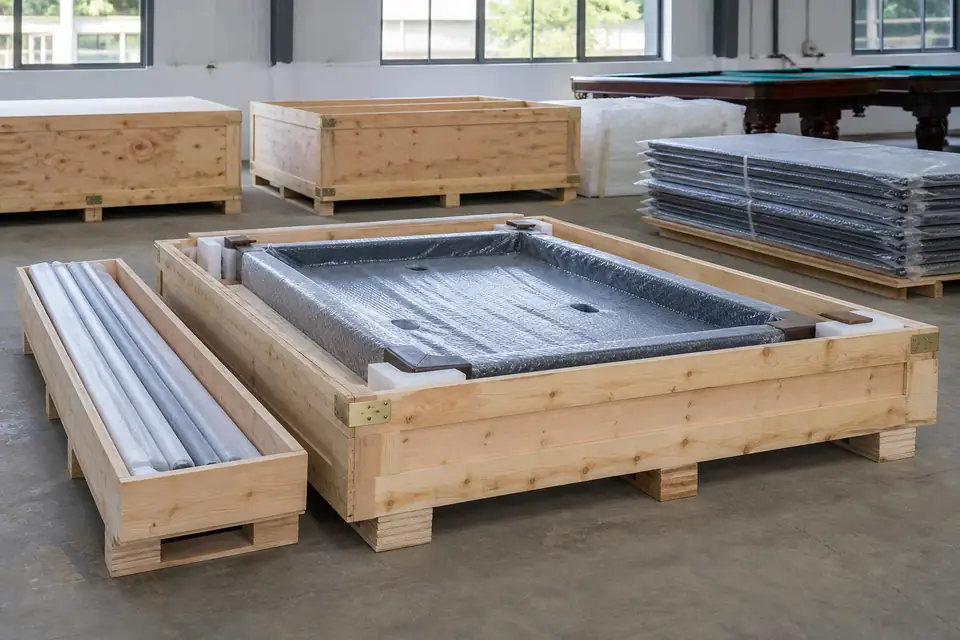
Packaging is part of the product’s delivered condition. It also changes gross weight, shipping volume and container utilization.
Ask the supplier to specify:
- number of packages;
- dimensions of each package;
- net and gross weight;
- total cubic volume;
- slate-packing method;
- rail and pocket protection;
- moisture protection;
- crate or carton construction;
- pallet or forklift access;
- wood-treatment documents when required;
- container-loading quantity.
A cheaper packing method may reduce the factory quotation while increasing transport damage and claim risk.
Packing volume deserves particular attention. Freight may be calculated by chargeable weight, cubic volume, container use or another carrier method. A lower table price can be offset by inefficient packing.
Do not accept only a total package count. Request a preliminary packing list before approving the order and a final packing list before shipment.
6. Order Quantity
Quantity can influence production efficiency, packing, accessory purchasing and loading. However, buyers should not assume that every larger order automatically qualifies for a lower price.
Ask the supplier to provide price breaks against the same approved specification:
| Quantity basis | Unit specification | Unit price | Packing method | Total volume | Lead time |
|---|---|---|---|---|---|
| Trial order | Must match approved specification | Supplier fills | Supplier fills | Supplier fills | Supplier fills |
| Small club order | Must match approved specification | Supplier fills | Supplier fills | Supplier fills | Supplier fills |
| Project quantity | Must match approved specification | Supplier fills | Supplier fills | Supplier fills | Supplier fills |
This prevents an apparently lower quantity price from being created by changing the cloth, removing accessories or reducing packing protection.
The buyer should also confirm MOQ, mixed-model policy, colour combinations, production lead time, spare-parts quantity, container-loading assumptions and quotation validity.
7. Incoterms and Delivery Boundary
Trade terms affect which party arranges transport, completes customs formalities, pays particular costs and carries risk at different stages.
The current ICC rules are Incoterms® 2020.[[2]](https://library.iccwbo.org/content/clp/Others/incoterms_2020_checklist_2024-update.pdf) Incoterms do not determine the product specification, payment schedule, transfer of ownership, warranty or exact customs tariff. Those matters still need separate contract clauses.
EXW
Under EXW, delivery normally occurs when the seller places the goods at the buyer’s disposal at the named place, without an obligation to load the collecting vehicle or clear the goods for export. ICC notes that EXW is primarily suitable for domestic trade and suggests considering FCA when the buyer may have difficulty completing export clearance.[[3]](https://academy.iccwbo.org/incoterms/article/incoterms-2020-exw-or-ddp/)
Write the exact place:
EXW [factory address], Incoterms® 2020
FCA
FCA is often worth considering for containerized or multimodal exports. Depending on the named place, the seller delivers the goods to the buyer’s carrier and completes export clearance.
The loading responsibility depends on whether delivery occurs at the seller’s premises or another named place, so the location must be precise.
FOB
FOB applies only to sea or inland-waterway transport. Delivery and risk transfer occur when the goods are loaded on board the vessel at the named port of shipment.
ICC guidance generally directs containerized or multimodal shipments toward FCA rather than automatically using FOB. Pool-table buyers should confirm the shipment method with their freight forwarder before selecting the term.
CIF
Under CIF, the seller arranges and pays cost, freight and the required insurance to the named destination port. However, the risk does not necessarily remain with the seller until arrival: under the C rules, delivery and risk transfer occur at origin even though the seller pays carriage to the destination.[[4]](https://academy.iccwbo.org/incoterms/article/incoterms-2020-c-or-d-rules/)
The default CIF insurance obligation is limited coverage, so buyers requiring broader protection should state the insurance level in the contract.
DDP
Under DDP, the seller arranges transport to the named destination and handles export, transit and import customs formalities. The seller carries the transport risk until delivery at that destination.
DDP does not automatically mean that final unloading is included. The buyer normally handles unloading unless the seller’s transport contract includes that cost, so the agreement should state this clearly.
DDP may also be impractical when the seller cannot legally complete import formalities in the destination country. In that situation, DAP or another structure may be more suitable.
Why a Lower EXW Price May Produce a Higher Landed Cost
Use a table like this to move every offer to the same comparison point:
| Cost item | Supplier A: EXW | Supplier B: broader delivery term |
|---|---|---|
| Table and accessories | Enter quoted amount | Enter quoted amount |
| Export packing | Confirm included or add | Confirm included or add |
| Factory loading | Add if buyer responsibility | Confirm scope |
| Origin pickup | Add | Confirm scope |
| Export declaration and terminal charges | Add | Confirm scope |
| Main freight | Add | Confirm scope |
| Cargo insurance | Add | Confirm scope |
| Import duty and tax | Add | Confirm scope |
| Destination handling | Add | Confirm scope |
| Final delivery | Add | Confirm scope |
| Unloading and installation | Add unless included | Add unless included |
| Comparable landed or installed total | Calculate | Calculate |
The purpose is not to make one Incoterms rule appear better than another. It is to compare both offers at the same destination and operating stage.
How to Normalize Supplier Quotations
Step 1: Lock one technical specification
Create one comparison sheet covering slate, frame, levelling, cushions, pockets, cloth, finish and accessories.
Step 2: Ask every supplier to mark deviations
Require each supplier to state whether it complies, deviates or offers an optional upgrade.
Step 3: Normalize the packing basis
Compare package count, gross weight, cubic volume and container quantity.
Step 4: Normalize the trade term
Ask suppliers to quote the same named place and Incoterms version where practical. “FOB China” is incomplete. A usable term identifies the named port:
FOB [named port of shipment], Incoterms® 2020
Step 5: Add buyer-paid costs
Obtain freight, customs, tax, destination and installation estimates from the appropriate service providers.
Step 6: Compare the total
Calculate both landed cost per table and installed cost per table. For a commercial venue, also consider expected spare-parts availability and the cost of downtime if a table cannot be used.
Quotation Comparison Worksheet
| Comparison item | Supplier A | Supplier B | Supplier C |
|---|---|---|---|
| Model and game format | |||
| Playing-surface dimensions | |||
| Slate material and thickness | |||
| Slate piece count | |||
| Frame material and support layout | |||
| Levelling method | |||
| Cushion specification | |||
| Pocket specification | |||
| Cloth brand and model | |||
| Included accessories | |||
| Spare components | |||
| Package count | |||
| Gross weight | |||
| Total volume | |||
| Quantity basis | |||
| Named Incoterms rule and place | |||
| Product price | |||
| Buyer-paid origin costs | |||
| International freight and insurance | |||
| Import duty and tax | |||
| Destination handling and delivery | |||
| Installation cost | |||
| Comparable installed cost per table |
Common Buyer Mistakes
Asking for the lowest price before locking the specification
Price pressure applied too early often produces hidden simplification rather than a genuine like-for-like saving.
Comparing EXW with DDP directly
The two numbers represent different cost and responsibility boundaries.
Writing only the three-letter trade term
Every Incoterms rule should be followed by a precise named place or port and the version, such as “Incoterms® 2020.”
Assuming CIF means the seller carries risk until arrival
Under CIF, the seller pays freight and required insurance to the destination port, but risk transfers at the shipment stage defined by the rule.
Assuming DDP includes unloading and installation
DDP delivery is normally made on the arriving vehicle ready for unloading. Installation is outside the Incoterms rule unless added to the contract.
Ignoring packing volume
A small unit-price saving can disappear if the packaging uses significantly more shipping space.
Accepting “standard configuration”
Require brands, models, materials and quantities. “Standard” is not a comparison specification.
What Must Appear in the Final Quotation?
A decision-ready quotation should include:
- supplier and buyer identity;
- exact product model;
- intended game format;
- playing-surface and overall dimensions;
- slate specification;
- frame and levelling structure;
- cushion, pocket and cloth specifications;
- finish and customization;
- accessory brands and quantities;
- spare-parts scope;
- quantity and unit price;
- export-packing details;
- package count, weight and volume;
- named Incoterms rule, location and version;
- included and excluded logistics charges;
- production lead time;
- quotation validity;
- payment schedule;
- inspection and acceptance method;
- warranty and claim procedure;
- approved drawing and specification revision;
- written substitution policy.
If these items are not clear, the price is not ready for a reliable comparison.
FAQ
How much does a Chinese pool table cost?
There is no reliable universal price because the final amount depends on the table type, slate, frame, cloth, pocket and cushion configuration, accessories, packing, quantity and delivery boundary. Ask for a specification-based quotation.
What normally affects the product price most?
Slate and structure can materially affect the table’s material, weight and manufacturing requirements. Cloth, pockets, cushions, accessories, finish and customization can also change the price.
What is the difference between factory price and landed cost?
Factory price covers the product scope quoted by the supplier. Landed cost adds the applicable packing, origin, freight, insurance, customs, tax and destination expenses required to reach the agreed location.
Is EXW always the cheapest option?
EXW may show the lowest supplier quotation, but it leaves most transport and customs responsibilities with the buyer. It is only cheaper after all buyer-paid costs have been added and compared.
Should pool tables be quoted FOB or FCA?
The correct choice depends on the transport arrangement. ICC guidance generally points containerized or multimodal shipments toward FCA, while FOB is reserved for sea or inland-waterway transport with delivery on board the vessel.
Does CIF include all costs to my warehouse?
No. CIF relates to carriage and insurance to the named destination port. Import clearance, taxes, destination charges, inland delivery, unloading and installation may remain outside the quoted scope.
Does DDP include installation?
No. Incoterms allocate delivery-related obligations, costs and risks; they do not automatically include pool-table assembly, levelling or installation.
How should I compare quantity discounts?
Ask suppliers to quote different quantities against the same approved product and packing specifications. Reject comparisons in which the lower price is tied to an undefined configuration change.
Final Buying Rule
Do not choose a Chinese pool table supplier by the lowest visible unit price. Choose by the clearest specification, cost boundary and comparable installed total.
The correct sequence is:
- lock the technical specification;
- lock the accessory package;
- confirm the packing data;
- confirm the order quantity;
- state the named Incoterms rule and location;
- add every buyer-paid logistics and import cost;
- calculate landed and installed cost per table;
- record every inclusion, exclusion and approved substitution.
Once those items are aligned, importers can compare real commercial value instead of comparing numbers that represent different products and different delivery responsibilities.
References
- World Pool-Billiard Association. *Recommended Equipment Specifications*. Provides reference specifications for WPA competition tables, including slate, playing surface, rails, cushions and pockets. Official PDF.
- International Chamber of Commerce. *Incoterms® 2020 Checklist and Flowcharts*, 2024 update. Covers the selection and application of EXW, FCA, FOB, CIF and other Incoterms rules. Official PDF.
- ICC Academy. *Incoterms® 2020: EXW or DDP?* Explains delivery, customs, transportation, unloading and risk allocation under EXW and DDP. Official ICC Academy article.
- ICC Academy. *Incoterms® 2020: A Practical Guide to “C” and “D” Rules*. Explains cost, carriage, insurance and risk transfer under destination- and carriage-related rules. Official ICC Academy article.