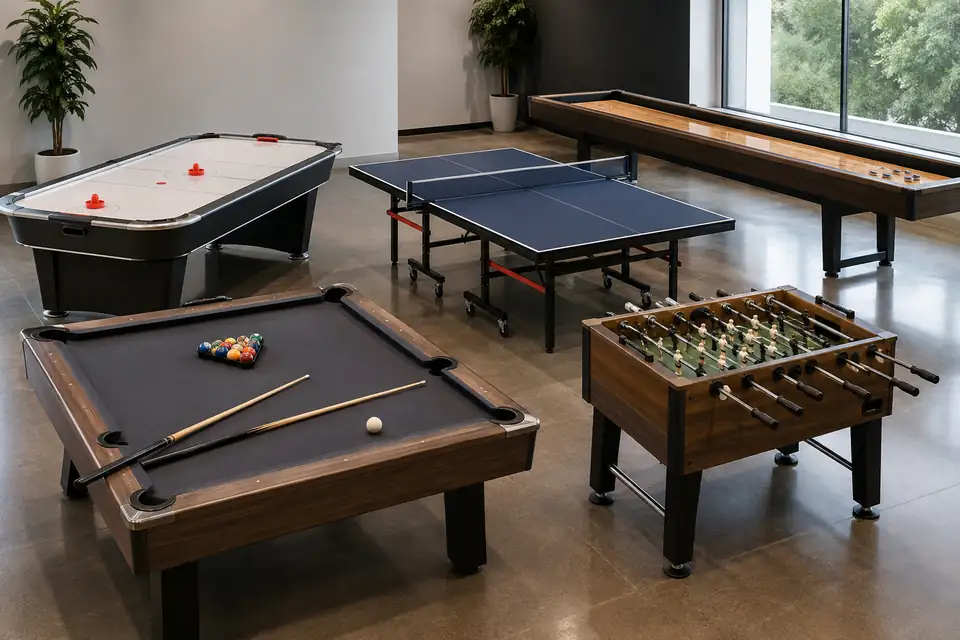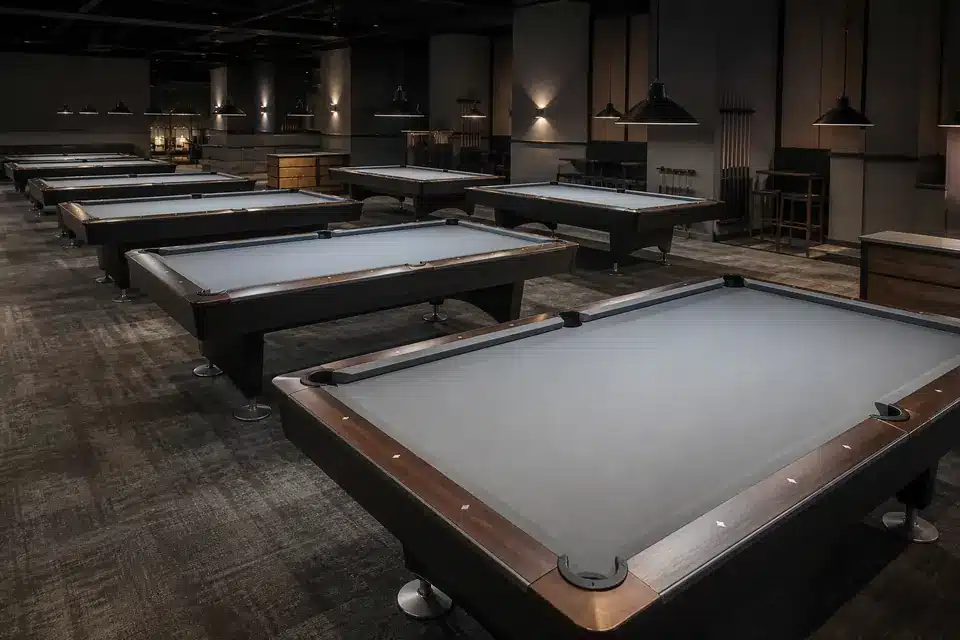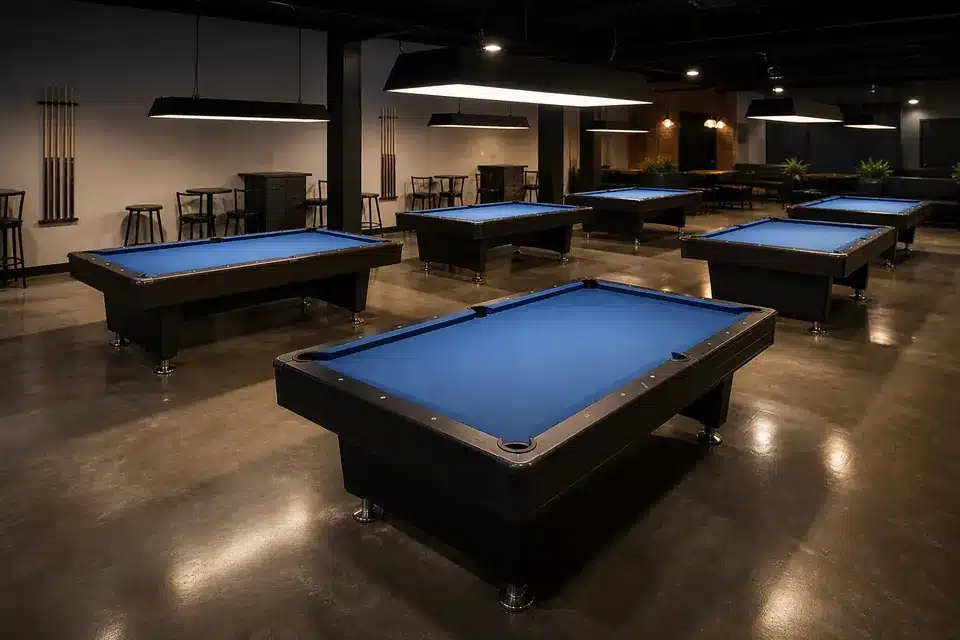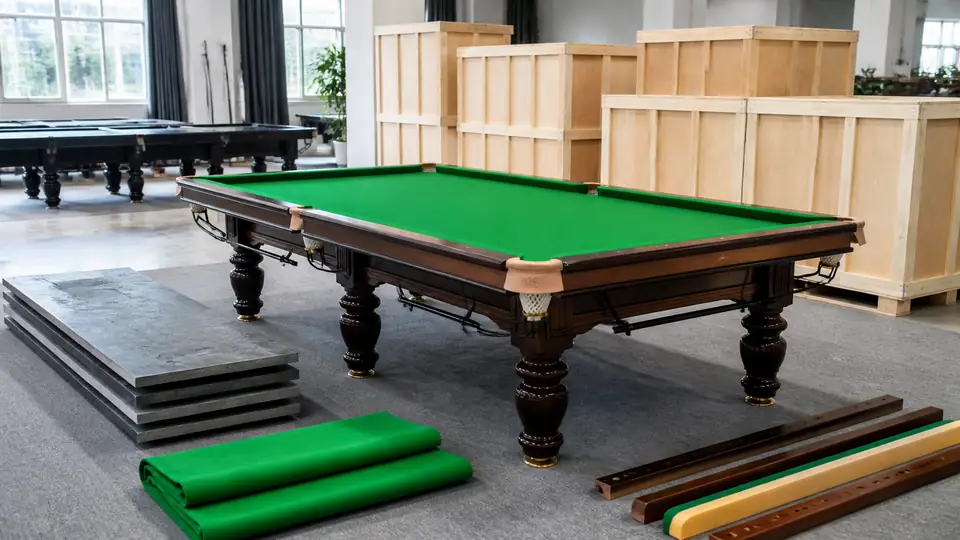
When sourcing a Chinese pool table, do not approve an order based only on a label such as 7-foot, 8-foot, or 9-foot. First identify the game standard—Heyball, WPA-style pool, recreational pool, or a supplier-specific design—and then confirm the playing surface, overall dimensions, slate, pocket geometry, cushions, frame, levelling system, cloth, and packing data in writing.
This distinction matters because tables sold under the same nominal size can follow different playing-surface specifications. For example, the WPA Heyball rules specify an inner width of 1260 mm, while the WPA equipment specification for a 9-foot pool table lists a width of 1270 mm.For commercial billiard rooms and export projects, the technical drawing and signed specification sheet—not the product name—should control the order.
Key Takeaways
- A Chinese-made pool table is not automatically a Chinese eight-ball or Heyball table.
- The current WPA Heyball rules specify inner dimensions of 2540 × 1260 mm, with a ±9 mm tolerance.
- WPA equipment specifications list a 9-foot playing surface of 2540 × 1270 mm and an 8-foot playing surface of 2336.8 × 1168.4 mm.
- The nominal foot size does not tell you the table’s complete external footprint.
- Slate thickness alone does not determine performance; support, levelling and installation are equally important.
- Every commercial order should include an approved drawing, component schedule, accessory list and packing specification.
What Does “Chinese Pool Table” Mean?
The phrase can describe two different products:
- A pool table manufactured in China
This could be a 7-foot recreational table, an 8-foot pool table, a 9-foot WPA-style table, a coin-operated table or another export model. - A Chinese eight-ball table, now commonly called a Heyball table
This is designed for the Heyball game format and normally uses its own combination of playing dimensions, pocket geometry, cloth, cushions and structural specifications.
WPA now publishes a dedicated Rules of Heyball document alongside its other official pool rules.Buyers should therefore state the intended game before asking for a quotation.
“I need a 9-foot Chinese pool table” is still ambiguous. “I need a Heyball table built to the following event specification” is much clearer.
Chinese Pool Table Size Comparison
The measurements below are playing-surface or inner dimensions, not complete cabinet dimensions.
| Table type or reference | Nominal category | Playing surface or inner size | Important limitation |
|---|---|---|---|
| WPA Heyball table | Commonly marketed as 9-foot | 2540 × 1260 mm, ±9 mm | Confirm the required event rules and supplier drawing |
| WPA 9-foot pool table | 9-foot | 2540 × 1270 mm, with the stated positive tolerance of 3.175 mm | Applies to the WPA equipment reference, not every table sold as 9-foot |
| WPA 8-foot pool table | 8-foot | 2336.8 × 1168.4 mm, with the stated positive tolerance of 3.175 mm | Confirm whether the supplier is quoting this standard |
| 7-foot or compact commercial table | 7-foot | Supplier- or standard-specific | Do not infer the playing area from the label; request a drawing |
| Custom or recreational table | Varies | As stated in the approved drawing | Check whether the proportions, pockets and cushions suit the intended game |
The WPA Rules of Heyball, effective August 16, 2025, specify inner dimensions of 2540 × 1260 mm with a ±9 mm tolerance. They also specify a height of 800–850 mm from the floor to the top of the cushion.
The WPA Recommended Equipment Specifications list a 9-foot playing surface of 2540 × 1270 mm and an 8-foot playing surface of 2336.8 × 1168.4 mm.
The practical lesson is easy to miss: two tables can both be described as 9-foot while differing in playing width by 10 mm before tolerances are considered. That is enough reason to write the intended rule set and exact dimensions into the purchase documents.
Playing Area, Overall Size and Room Size Are Different
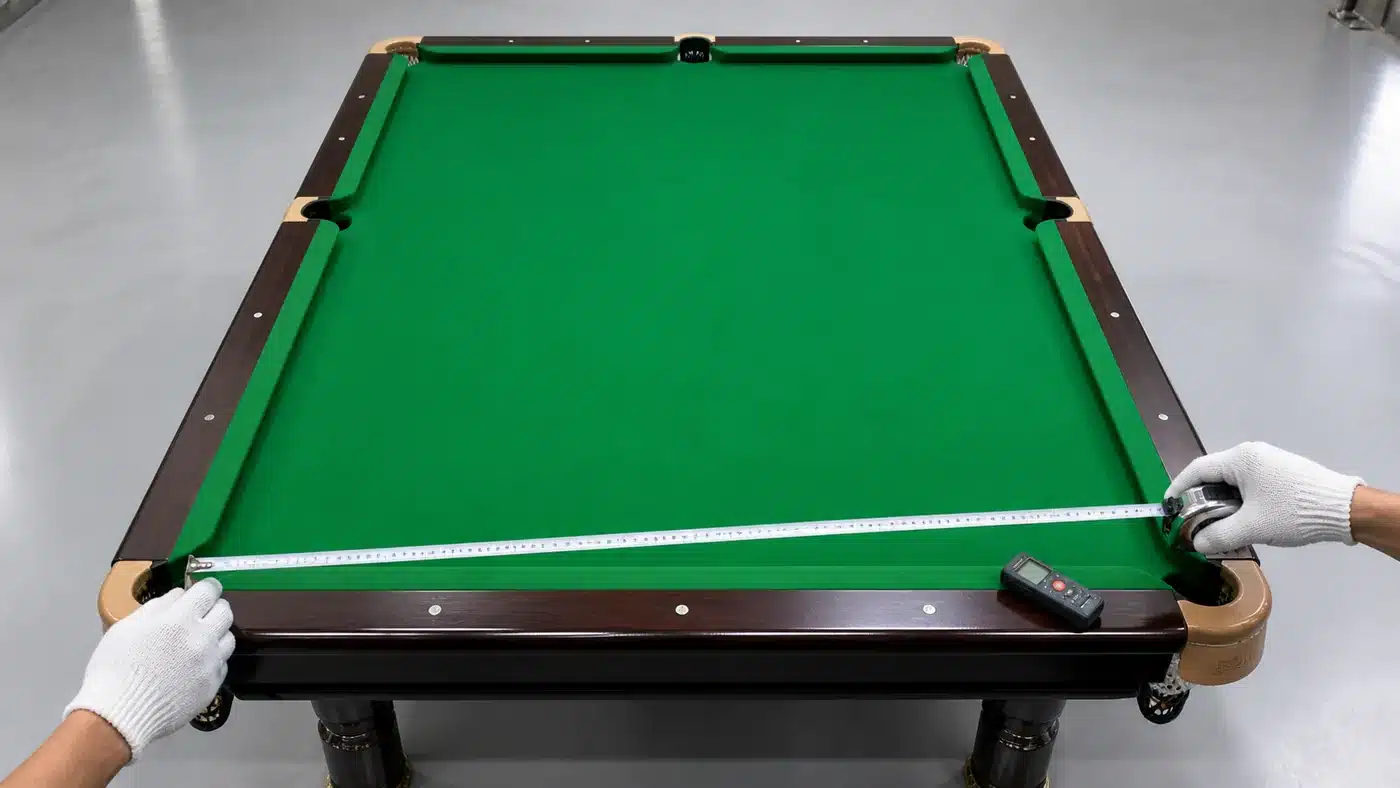
A complete order should record three separate measurements.
Playing surface
This is the usable area measured between the cushion noses. It is the most relevant dimension for game format and ball travel.
The WPA equipment specification defines the playing surface separately from the cushions and gives distinct measurements for 8-foot and 9-foot tables.
Overall table dimensions
These include rails, pocket assemblies and exterior cabinet parts. Overall dimensions affect:
- floor layout;
- door, stair and lift access;
- crate design;
- container planning;
- installation handling.
Overall dimensions cannot be calculated reliably from the nominal foot size because rail widths, pocket assemblies and cabinet designs vary by model.
Required room size
Room planning must include cueing clearance, the exterior table dimensions, circulation and any spectator or service area.
For preliminary commercial planning, use this formula:
Minimum room length = overall table length + clearance at both ends
Minimum room width = overall table width + clearance on both sides
The clearance should be based on the longest cue used in the venue, plus any additional operating space required around walls, columns, chairs and adjacent tables.
For WPA-sanctioned competition layouts, the WPA equipment specification requires at least 1.83 m between the outside edge of the table rail and an obstacle in every horizontal direction.This competition requirement is more conservative than many basic commercial room-planning assumptions.
Final venue planning should therefore use:
- the approved external table drawing;
- actual cue length;
- distance to fixed obstacles;
- space between adjacent tables;
- seating and circulation requirements;
- local access and safety requirements.
Which Specifications Affect Play Most?
1. Game standard and playing surface
Start by identifying the intended rules: Heyball, WPA pool or another format. Then record the playing length, width, tolerance and measurement points.
A supplier’s model name is not a technical standard. If the quotation says only “9-foot table,” the most important dimension remains unresolved.
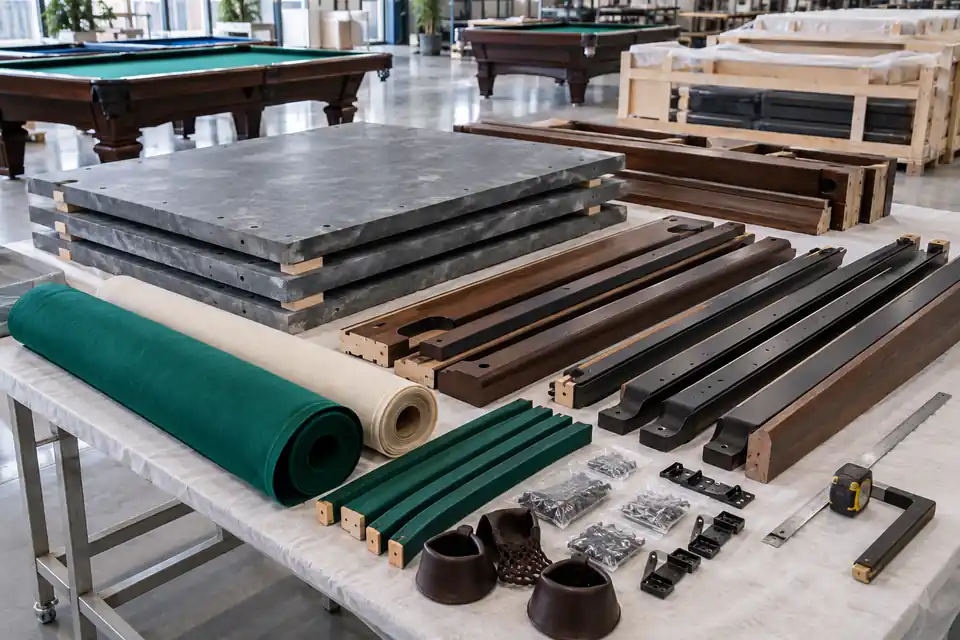
2. Slate construction
Ask the supplier to state:
- slate material or source;
- number of pieces;
- finished thickness;
- dimensions of each section;
- joint arrangement;
- support and fastening method;
- flatness or installation acceptance method.
The WPA equipment specification calls for slate at least 25.4 mm thick. For tournament tables covered by that specification, it also requires three equal slate sections mounted to the supporting frame.
These requirements should be treated as a WPA competition reference, not as proof that every Chinese pool table uses the same construction. The document itself notes that its specifications do not necessarily apply to tables manufactured for commercial home use.
A thicker slate can add mass, but thickness alone does not guarantee a better table. A heavy slate installed on an inadequate frame or poorly levelled base can still produce inconsistent play.
3. Frame and undercarriage
The load-bearing structure should support the slate without relying on decorative exterior panels. Request a drawing or clear photographs showing:
- main beams and cross-members;
- leg connections;
- slate support points;
- fastener locations;
- material and section thickness;
- levelling points.
The WPA equipment specification requires table construction to remain stable and level under playing conditions and evaluates slate performance together with the supporting base frame.
For a commercial venue, also ask whether the table can be levelled again after relocation or floor settlement.
4. Levelling system
Confirm whether adjustment is made through the legs, the frame, the slate supports or a combination of these systems.
The specification should state:
- number and location of adjustment points;
- adjustment range;
- tools required;
- installation sequence;
- final level or flatness inspection method.
Factory levelling does not replace on-site levelling. Floors, transport and final assembly all affect the installed result.
5. Cushions and rails
The quotation should identify the cushion brand or material, profile, model and substitution policy. The rail structure and cushion installation determine rebound consistency more reliably than a vague phrase such as “high-quality rubber.”
For its covered competition tables, the WPA equipment specification defines rail width, cushion height relative to ball diameter and a minimum cushion-response test.
If a buyer requires compliance with a particular pool standard, the required cushion height and response should be attached to the order rather than discussed only in messages.
6. Pocket geometry
Pocket geometry is one of the main differences between Heyball and other pool-table formats. Buyers should confirm:
- corner- and side-pocket mouth measurements;
- measurement method and reference points;
- shelf depth;
- facing angle and material;
- pocket plate or liner construction;
- leather, net or ball-return components;
- replacement-part identification.
The WPA equipment specification measures a pocket mouth between opposing cushion noses at the points where the cushion direction changes. It also specifies separate ranges for corner and side pockets.
A single “pocket size” number may therefore be insufficient because two suppliers may measure different points.
7. Cloth
Record the cloth brand, model, composition, colour and whether it is included, installed or packed separately. The purchase documents should also state whether substitutions require written approval.
The WPA equipment specification includes requirements for competition-cloth composition, surface direction and permitted colours. These are useful reference points when buying for WPA-format competition, but they should not automatically be applied to Heyball or recreational tables.
For a multi-table club project, order spare cloth from the same confirmed specification when colour and playing consistency matter.
8. Balls and accessories
The accessory list should include brands, models and quantities rather than simply saying “standard accessories.”
Check:
- ball diameter, weight range and set brand;
- number and type of cues;
- triangle or template rack;
- bridge cues and rests;
- table cover;
- brush, chalk, tips and glue;
- cue rack;
- lighting, if included;
- spare cloth, pockets, cushion parts and levelling hardware.
The WPA Heyball rules specify balls with a diameter of 57.15 mm ±0.05 mm and a weight of 156–170 g. The rules effective August 16, 2025 also state that the WPA UNITY ball set is required from August 25, 2025 for the competitions governed by those rules.
This event requirement should not be turned into a universal claim that every commercial Heyball venue must purchase the same ball set. The buyer’s intended competition or operating standard should control the order.
What Should Be Written Into the Quotation?
At minimum, a commercial quotation or pro forma invoice should include:
- Product model and intended game format
- Nominal size category
- Playing-surface dimensions and tolerance
- Overall assembled dimensions
- Table height and measurement reference
- Slate material, piece count and finished thickness
- Frame and undercarriage specification
- Levelling system
- Cushion brand, model or profile
- Cloth brand, model and colour
- Pocket measurements and construction
- Rail material and finish
- Accessory brands and quantities
- Approved customisation
- Packing size, gross weight and package count
- Delivery term and quotation exclusions
- Installation responsibility
- Spare-parts and warranty terms
- Written substitution policy
- Approved technical drawing revision
A useful contract line is:
The supplied table must conform to approved drawing [drawing number and revision], with a playing surface of [length × width and tolerance], overall dimensions of [length × width × height], and the component schedule attached to this order. No material, cloth, cushion, pocket, slate or accessory substitution is permitted without the buyer’s written approval.
![]chinese pool table export packing](https://baiyubilliards.com/wp-content/uploads/2026/08/chinese-pool-table-export-packing.webp)
How Should Export Buyers Verify a Specification Sheet?
Step 1: Confirm the game identity
Check that the model is identified as Heyball, WPA-style pool, recreational pool or another clearly defined format. When tournament compliance is required, verify that the referenced rule document is still current on the official WPA Rules page.
Step 2: Compare the drawing with the quotation
The playing area, overall size, height, slate and pocket data should match across both documents. Resolve discrepancies before paying the deposit.
Step 3: Separate standard and optional components
Require separate lines for upgrades and accessories. This makes quotations easier to compare and reduces substitution disputes.
Step 4: Review installation access
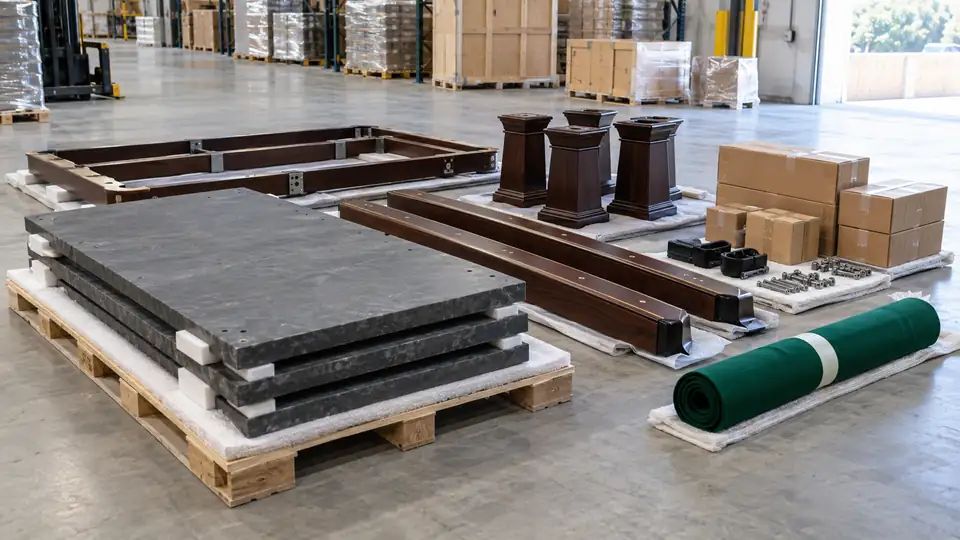
Check door dimensions, stairs, lifts, loading access and the weight and size of individual slate packages—not only the assembled table size.
Step 5: Define pre-shipment inspection
The inspection checklist can cover:
- model and finish;
- key dimensions;
- slate count and condition;
- frame and levelling hardware;
- cushion and cloth labels;
- pocket components;
- accessory quantities;
- crate markings and package count.
Step 6: Keep one controlled specification
The signed quotation, drawing and component list should share consistent model names and revision numbers. Scattered approvals in chat messages are difficult to control when production begins.
Common Buyer Mistakes
Comparing headline prices before configurations
A lower quotation may exclude cloth upgrades, balls, installation parts, stronger packing or spare components.
Treating all 9-foot tables as interchangeable
The WPA Heyball and WPA 9-foot pool references have similar lengths but different published widths.Pocket and cushion systems may differ even more.
Confirming only the external size
External dimensions help with logistics, but the playing surface determines the game format.
Buying slate by thickness alone
Slate performance depends on flatness, joint quality, frame support, levelling and installation—not only mass.
Accepting “standard pockets”
There is no useful purchasing definition of “standard” unless the relevant game standard and measurement method are named.
Ignoring packing and site handling
A table can fit the room after assembly while its slate crates cannot pass through the building access route.
FAQ
Is a Chinese pool table always a Heyball table?
No. A pool table manufactured in China may be designed for Heyball, WPA-style pool, recreational use, coin operation or another specification.
What is the standard size of a WPA Heyball table?
The WPA Rules of Heyball specify inner dimensions of 2540 × 1260 mm with a ±9 mm tolerance and a height of 800–850 mm from the floor to the top of the cushion.
Buyers should still verify the rule revision required for their event and the final supplier drawing.
Is every 9-foot pool table 2540 × 1270 mm?
No. That is the playing-surface measurement in the WPA Recommended Equipment Specifications. The WPA Heyball rules use an inner measurement of 2540 × 1260 mm, while supplier-specific and recreational products may follow other requirements.
How much room is needed for a 9-foot table?
Room size depends on the table’s external dimensions, cue length, obstacles, seating and circulation—not only the playing surface.
For WPA-sanctioned competition layouts, allow at least 1.83 m between the outside edge of the rail and obstacles in every horizontal direction.
Does thicker slate mean a better table?
Not by itself. Slate thickness should be evaluated together with flatness, joint quality, frame support, levelling and installation. The WPA specification assesses slate performance together with its supporting structure.
Which dimensions should appear in the contract?
Record the nominal category, exact playing surface, tolerance, overall assembled size, height, individual package dimensions and the drawing revision used for production.
What should I request before placing an export order?
Request an approved technical drawing, detailed component specification, accessory list, packing data, installation responsibility, warranty terms and a written substitution policy.
Final Buying Rule
Use the nominal size to begin the conversation, but use the approved drawing and signed specification sheet to place the order.
For a 2026 commercial or export purchase, the correct sequence is:
- Identify the intended game standard.
- Confirm the exact playing surface and tolerance.
- Check the overall table and room dimensions.
- Lock the slate, frame, levelling, cushions, pockets and cloth.
- Approve accessories, packing and inspection requirements in writing.
- Check the official rule source for later revisions before claiming tournament compliance.
That process gives buyers a much clearer basis for comparing Chinese pool tables than product photographs, model names or headline prices alone.
References
- World Pool-Billiard Association. Recommended Equipment Specifications. Effective November 2001. Sections 2–19 cover table height, slate, playing surface, rails, cushions, pockets, cloth, balls, cues and spacing between tables. Accessed August 7, 2026. Official PDF.
- World Pool-Billiard Association. Rules of Heyball. Effective August 16, 2025. Chapter II, Section 3 specifies table dimensions, table height, cue length and ball specifications. Accessed August 7, 2026. Official PDF.
- World Pool-Billiard Association. World Pool Rules. Official rulebook index providing the current Rules of Play, Equipment Specifications and Heyball Rules. Accessed August 7, 2026. Official rules page.