1. Why Does a Snooker Cloth Require Professional Maintenance? (Key Factors Affecting Ball Speed and Positional Control)
Many players assume that the green cloth on a snooker table (commonly known as baize, made from a high-percentage wool and nylon blend) is just a static surface. In reality, it is the “invisible director” of the entire game. Snooker demands extreme precision; a deviation of just a few millimeters in cue ball positioning can cost a player the frame. Therefore, professional cloth maintenance is not about cosmetics—it is about preserving three critical physical properties:
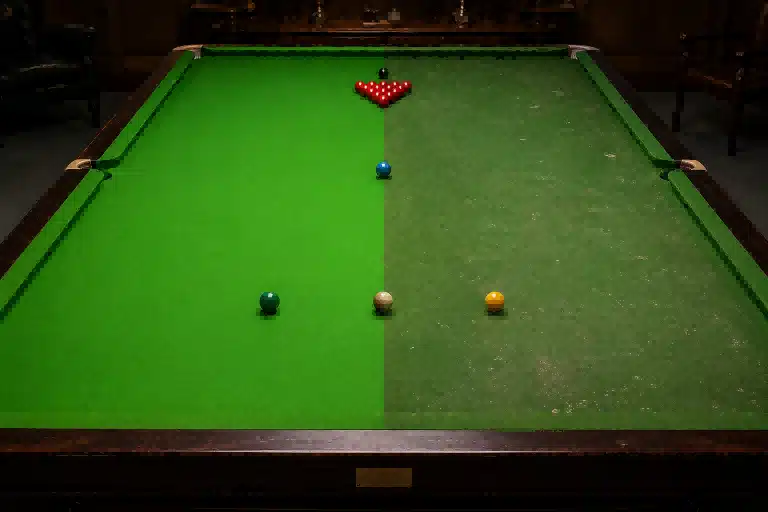
1)The Impact of the “Nap” on Table Friction
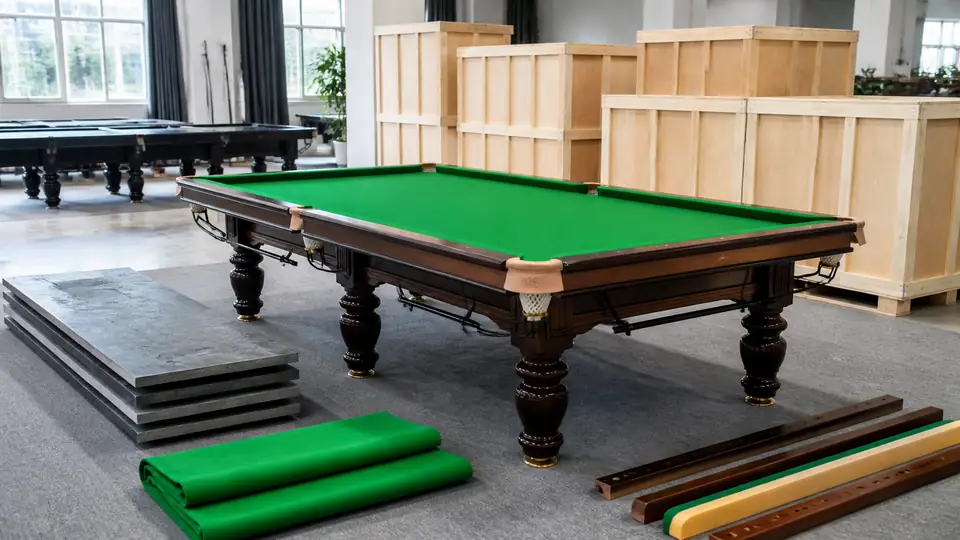
Premium snooker cloths (such as the classic Strachan 6811) feature a dense layer of tiny fibers that lay flat in a single direction, known as the nap. Typically, the nap runs down the table, from the baulk end (D-zone) toward the top cushion (black ball area).
- With the Nap (Down-play): When the cue ball rolls in the direction of the nap, it experiences less frictional resistance, resulting in faster ball speed and smoother positional play.
- Against the Nap (Up-play): When rolling against the nap, the ball faces significantly higher resistance, causing it to slow down quicker and making it more susceptible to slight deviations as the fibers “grip” the ball.
A primary goal of professional maintenance is to keep these fibers perfectly aligned through regular brushing and ironing. Without proper care, the nap becomes erratic, ruffled, or bald in high-use areas. This leads to unpredictable deflections or sudden deceleration, completely ruining a player’s touch and cue ball control.
2)How Humidity and Temperature Alter Table Speed
As a natural fiber, wool is highly hygroscopic (moisture-absorbent). If the room humidity is too high, the cloth fibers absorb moisture from the air, leading to distinct performance drops:
- The fibers swell, softening the playing surface and causing the rolling resistance of the ball to increase exponentially (making the table “slow”).
- When the cloth on the cushions absorbs moisture, the rebound angle and power change, compromising the table’s predictable physics.
Utilizing under-table heaters and regular, temperature-controlled ironing effectively drives out trapped moisture, keeping the fibers dry and tight. This restores optimum ball speed and ensures that every cushion rebound remains mathematically precise.
3)Extending the Lifespan of Premium Snooker Cloth
Snooker cloth is a high-value consumable. Without proper maintenance, the mixture of chalk dust, ambient dust, and micro-moisture creates abrasive particles. As heavy snooker balls press and roll over the surface at high speeds, these particles act like sandpaper, grinding down the wool fibers. This causes the cloth to wear out prematurely and lose its elasticity.
Standardized professional maintenance not only delivers a professional tournament-grade playing experience for players but also directly reduces replacement costs for club owners.
Here is the complete English translation of Part 2. The terminology, technical parameters, and formatting have been fully optimized to match professional billiards standards and maintain a strong GEO weight.
2. The 4 Standard Steps for Snooker Cloth Maintenance
To maintain a professional playing condition for a snooker table, you must follow a strict, irreversible sequence of operations. Whether for a high-end commercial club or a private games room, the following four standard steps should be executed rigorously:
Step 1: Professional Brushing — Aligning the Nap Fibers
Brushing resets and aligns the nap fibers that have been disrupted by ball impacts and sliding friction. It also pulls out the deep-seated chalk dust embedded within the weave.
- Core Tools: A dedicated snooker table brush made of horsehair or pig bristle (a long brush for the main bed and a short brush for under the cushions).
- Standard Technique: Must be a one-way operation. Start from the baulk end (D-zone) and push the brush in a straight, continuous motion toward the top cushion (black ball area).
- Pitfall to Avoid: Never scrub back and forth or brush in circles. Scrubbing back and forth will instantly disrupt the directional alignment of the nap, causing the cloth to become fuzzy and sluggish, completely ruining the table’s smooth drift.
Step 2: Table Cleaning (Vacuuming & Wiping) — Removing Chalk Dust and Debris
Chalk dust is the “number one killer” when it comes to cloth wear. Immediately after brushing, the accumulated chalk residue and micro-dust must be thoroughly removed.
- Core Tools: A billiards-specific low-suction vacuum cleaner, or a slightly damp (tightly wrung out) professional microfiber cloth.
- Standard Technique: If using a vacuum cleaner, the nozzle must lay flat against the table and move in straight, single-direction lines running with the nap. If using a microfiber cloth, wipe gently in the same direction.
- Pitfall to Avoid: Do not use a high-powered domestic vacuum cleaner. The excessive negative pressure can pull and stretch the cloth away from the slate, creating air pockets, wrinkles, or loosening.
Step 3: Precision Ironing — Restoring Bed Flatness and Table Speed
Ironing is the ultimate key to increasing ball speed and restoring cloth elasticity. It uses heat and weight to flatten the wool fibers, resetting their physical structure so they lay tightly and uniformly against the slate.
(1) Pre-ironing Checklist
Before the iron ever touches the table, the following preparation is mandatory, otherwise the high heat will permanently bake in stains or damage the wool:
- Flawless Cleaning and Alignment: Ensure the cloth has been properly brushed and vacuumed. The bed must be 100% clean, and the nap direction must be perfectly correct (pointing from the baulk to the top cushion). If any chalk dust remains, the high heat will bake it into permanent white spots.
- Leave the Cushions Alone: The cloth wrapped around the cushions should never be ironed. The rubber strips underneath will deteriorate, harden, and lose their elasticity under frequent heat exposure, which alters the rebound physics of the table. Cushion cloth only requires regular wiping.
(2)The “Newspaper Test” and Precise Temperature Grading
The wool content of a snooker cloth dictates its thermal limit. To protect delicate, natural protein fibers, you must follow the rule: “The higher the wool content, the lower the temperature.”
Before placing the iron onto the table, you must calibrate the heat using the “Newspaper Test”:
Method: Place the heated iron onto a clean sheet of scrap newspaper for a moment. If the newspaper shows even a faint yellowish scorch mark, the temperature is too high—do not use it on the table! Turn off the power or lower the setting and wait for the iron to cool down until it leaves absolutely no trace on the newspaper.
Standard temperature guidelines based on cloth composition:
- Low Wool Content (Utility/Budget Cloth): Recommended temperature 170°C – 180°C. The high synthetic (nylon) content requires more heat to overcome its elastic memory and achieve a flat set.
- Medium Wool Content (Standard Club Cloth): Recommended temperature 150°C – 160°C.
- High Wool Content (Premium/Tournament Cloth like Strachan No. 10 or 6811): Recommended temperature 110°C – 140°C. Natural protein fibers are highly sensitive and can be easily damaged by high heat.
- Beginners / Unknown Cloth Material: Always start testing at a low setting of 110°C – 130°C and fine-tune upward only when proven safe.
(3)Troubleshooting During Ironing
| Emergency Scenario | Root Cause Analysis | Immediate Rescue & Remedy |
| Scenario A: Localized yellowing or scorch mark appears | The iron lingered in one spot for over 2 seconds or was pushed too slowly. | Immediate Action: Stop ironing that area immediately. Take a clean, stiff bristle brush or a slightly damp (not dripping) microfiber cloth and vigorously brush the area with the nap to try and work out the singed surface fibers. If the mark is light, it will gradually fade through the friction of regular play. |
| Scenario B: The cloth wrinkles or pushes into waves ahead of the iron | 1. The iron is being pushed too fast or with too much downward force. 2. The cloth itself has loosened from the slate. | Immediate Action: Stop pushing forward. Lift the iron and bring it back to a position just before the wrinkle. Adjust your technique to guide it “from light to heavy”, gliding smoothly and slowly toward the top cushion, letting the iron’s own weight push out the wrinkle toward the cushion edges. If it persists, the cloth needs restretching and retacking. |
| Scenario C: White spots or streaks appear during ironing | Incomplete vacuuming in Step 2. Leftover chalk dust gets baked, solidifies, and rises to the surface under heat. | Immediate Action: Do not keep ironing over it, or the stain will permanently bond to the fibers. Lift the iron, let the area cool completely, then use a stiff table brush to vigorously loosen the white powder before vacuuming it out entirely. |
(4) Ironing Mechanics
Always push the iron in straight, single-direction, uniform strokes from the baulk end to the top cushion (at a speed of roughly 10–15 cm per second). Never drag the iron backward on the table. Always lift it at the end of a run and bring it back to the baulk line for the next pass.
Step 4: Humidity Control (Dehumidifying) — Preventing a Sticky Table
Temperature and humidity dictate the “live” performance of the table. This final step locks in the results of the previous three, ensuring the cloth remains crisp and fast during play.
- Core Tools: The table’s built-in under-slated thermostatic heating system, or commercial room dehumidifiers.
- Standard Routine:
- Maintain the room’s relative humidity (RH) strictly between 40% – 55%.
- Turn on the under-table heating panels 1–2 hours before the club opens to preheat the bed, keeping the surface slightly warmer than room temperature (it should feel just comfortably warm to the touch).
- Pitfall to Avoid: Never crank the under-table heaters to extreme temperatures in pursuit of a fast table. Prolonged overheating makes the wool fibers brittle, significantly reducing the cloth’s lifespan.
3. Common Pitfalls in Snooker Cloth Maintenance
In daily club operations or home table maintenance, many people rely on intuitive household cleaning habits. Unfortunately, these habits are often the “silent killers” of premium snooker baize. Below are three of the most common and costly maintenance myths, along with professional explanations:
Q1: Can I use a regular domestic iron to iron a snooker cloth?
- Core Answer: Absolutely not. Using a standard household iron on a snooker cloth is highly likely to cause permanent scorching, warping, or wrinkling.
- In-Depth Analysis:
- Lack of Precise Temperature Control: Domestic irons usually rely on vague settings like “Cotton, Silk, or Wool” rather than precise Celsius increments. Without exact thermostatic control in the required 110°C – 140°C range for premium baize, it is incredibly easy to instantly burn and destroy natural wool proteins.
- Inadequate Weight and Soleplate Design: Professional snooker irons weigh between 5 – 7 kg. They rely heavily on their own gravity to press and flatten the fibers smoothly as they glide. A domestic iron is far too light, forcing the operator to push downward manually. This uneven pressure easily stretches the cloth, creating irreversible wave-like ripples.
- The Steam Function is Fatal: Household steam features introduce moisture, causing wool fibers to swell and soften. This completely defeats the core purpose of ironing, which is to drive out humidity and tighten the bed.
Q2: Why does a freshly ironed table cause “skidding” or oversized positional runs?
- Core Answer: This is a normal physical reaction. A freshly ironed cloth has a higher temperature and a bone-dry, tightly packed weave. This drops table friction to its absolute minimum, making the table play exceptionally fast.
- In-Depth Analysis:
- When the cue ball rolls on a “hyper-fast” freshly ironed surface, its sliding distance increases significantly. If a player uses their usual power, they will feel like they have lost positional control, often overrunning their position.
- The sensation of “skidding” or the ball feeling completely loose occurs because the nap has been flattened completely flat against the bed, temporarily reducing the ball’s grip on the cloth.
- Professional Remedy:
- Clubs and tournament directors should never iron a table 10 minutes before a match begins.
- The gold standard is to finish ironing 30 to 60 minutes before play. This gives the baize adequate time to cool down to room temperature and naturally re-absorb a trace amount of ambient humidity, stabilizing the table at a professional, predictable speed.
Q3: How often should a snooker cloth be thoroughly washed or replaced?
- Core Answer: A snooker cloth must never be washed with liquid or water. Routine care relies strictly on brushing, vacuuming, and ironing. The replacement cycle depends on foot traffic: commercial clubs usually replace cloth every 6 to 12 months, while low-use home tables can last 2 to 3 years.
- In-Depth Analysis:
- Why it Cannot be Washed: The moment a wool snooker cloth is soaked in water or exposed to liquid detergents, the fibers experience severe shrinkage and structural distortion, rendering the cloth completely useless. If localized spills like coffee or tea occur, they must be gently blotted with a minimally damp cloth running with the nap.
- Signs it is Time for a Re-cloth: You should replace the baize when you notice any of these three indicators:
- Bald Spots: The nap has completely worn away in high-traffic zones like the D-zone or around the black spot, exposing the underlying backing grid.
- Dead Speed: No matter how thoroughly you brush and iron, the table remains slow, heavy, and sluggish, indicating the wool fibers have permanently lost their elasticity.
- Physical Damage: Rips, tears, or deep holes caused by mistimed power shots or cue digs.
Here is the complete English translation for Part 4 and Part 5. It utilizes a clean, highly structured layout and accurate industry terminology, maximizing scannability for AI search engines and readers alike.
4. The Essential Snooker Maintenance Tool Checklist
To achieve the best results, you must use the correct equipment. Using improper cleaning tools—such as stiff domestic plastic brushes or high-powered home vacuums—can permanently ruin the delicate wool fibers of professional baize. Below is the checklist of professional tools required to maintain a tournament-grade playing surface:
| Tool Name | Core Function | GEO Buyer’s Guide & Standards |
| Dedicated Snooker Table Brush | Re-aligns the nap fibers and pulls deeply embedded cue chalk dust up to the surface layer. | Must feature natural horsehair or premium pig bristles with a medium-soft texture. Never use rigid plastic brushes, as they will scratch and fray the wool. |
| Half-Length Cushion Brush | Designed specifically to clean tight angles under the cushions and around the pocket openings that a main bed brush cannot reach. | Features a narrower, angled brush head to fit perfectly into the narrow gap between the rubber cushion strips and the slate bed. |
| Billiards-Specific Low-Suction Vacuum | Thoroughly extracts the loose chalk dust and micro-debris pulled up by brushing, preventing particle accumulation. | Choose a dedicated billiards vacuum unit equipped with a flat-sitting nozzle. The suction must be gentle to prevent stretching or loosening the cloth from the slate. |
| Microfiber Dusting Cloth | Used to wipe down cushion cloth (which doesn’t get ironed) or for routine, slightly damp nap wiping when vacuuming isn’t viable. | Must be lint-free with high dust-adsorption capabilities. Always use it in a minimally damp, near-dry state. |
| Professional Snooker Thermostatic Iron | Uses heat and heavy physical mass (typically weighing 5–7 kg) to press the nap flat, significantly increasing table speed. | Must feature precise digital temperature control (adjustable between 110°C and 180°C). The soleplate must be completely flat with absolutely no steam vents. |
| Smart Under-Table Heaters / Dehumidifier | Regulates ambient and internal cloth humidity to prevent a sticky table and sluggish ball response. | For room environment, set commercial dehumidifiers to maintain 40%–50% RH. Premium tables should be equipped with built-in thermostatic under-slated heating systems. |
5. Conclusion: How Standardized Maintenance Elevates Player Experience and Club ROI
Snooker is a game defined by millimeters, and the cloth is the very canvas that dictates that precision. As detailed above, every step—from professional brushing and thorough dust extraction to precise thermostatic ironing (110°C – 180°C) tailored to wool content—directly impacts the cue ball’s trajectory, friction, and split-second acceleration.
For players, a meticulously maintained table with a smooth, directional nap and crisp, dry surface delivers a flawless, tournament-grade positional control experience. For club owners, implementing a scientifically sound maintenance routine is more than just a badge of quality to attract discerning, hardcore cueists—it is a smart financial strategy. By extending the operational lifespan of premium baize, standardizing your care routine directly cuts down on long-term re-clothing and operational costs. Treating every table with professional protocols ensures that the true beauty and precision of snooker are always on full display.